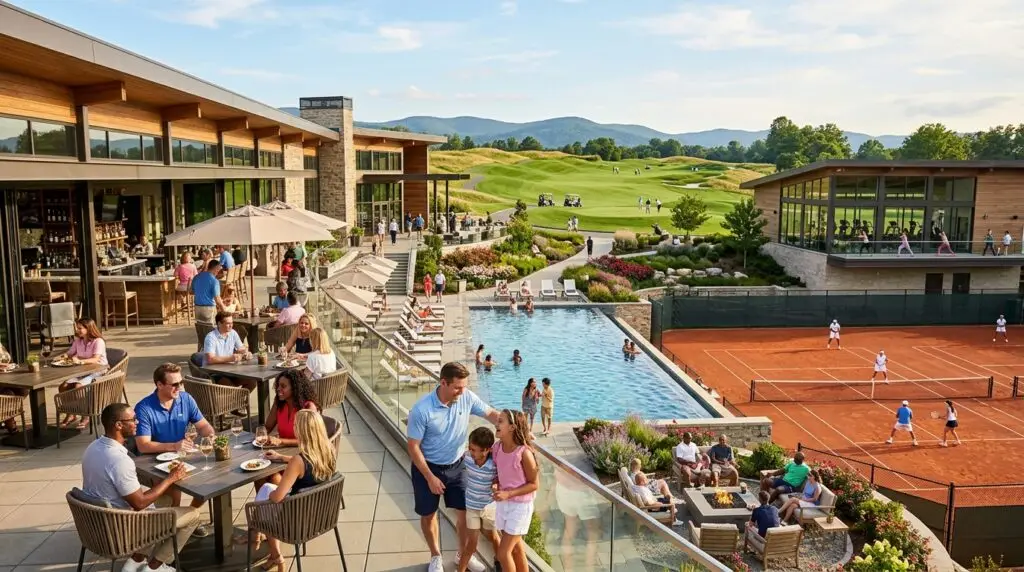
A modern country club is no longer defined by the golf course alone.
Golf may remain the foundation, but the complete experience can now include dining, fitness, aquatics, tennis, pickleball, family programming, private events and a year-round social community.
This broader model serves several different types of members:
- Golfers seeking regular course and practice access
- Families looking for shared recreation
- Non-golfers interested in dining, fitness or social events
- Professionals using the club for hospitality and connection
- Retirees building an active weekly routine
- Couples with different recreational interests
The defining feature of a modern club is not the number of amenities printed on its website.
It is how those amenities work together to create a place members can use throughout ordinary life, not only during an occasional round of golf.
The modern country club experience combines golf with recreation, wellness, dining, family activities, events and community. Members may visit for a full round, a short fitness session, pool time, pickleball, dinner, a celebration or a social event, often using several parts of the club during the same visit.
What Is a Modern Country Club?
A modern country club is a private membership community that combines recreational facilities, hospitality, social programming and shared experiences within one club environment.
Its amenities may include:
- Golf course and practice facilities
- Professional instruction
- Fitness center
- Swimming pool
- Tennis and pickleball
- Dining rooms and lounges
- Family programming
- Member tournaments
- Social events
- Weddings and private celebrations
- Corporate functions
- Outdoor recreation
The word modern does not simply mean that the clubhouse has newer furniture or faster Wi-Fi.
It means the club has expanded from a single-purpose golf facility into a multi-activity environment designed for different ages, schedules and interests.
Traditional Country Club vs. Modern Country Club
| Traditional Perception | Modern Country Club Experience |
| Primarily focused on golf | Golf plus recreation, wellness and hospitality |
| Designed mainly for adult golfers | Designed for individuals, couples and families |
| Formal social occasions | Formal, casual and family-oriented events |
| Limited non-golf activities | Fitness, swimming, tennis, pickleball and more |
| Clubhouse used mainly after golf | Clubhouse used for dining, events and daily social life |
| One primary member interest | Multiple interests across one household |
| Occasional major gatherings | Recurring year-round programming |
| Golf-centered membership | Golf, family and social membership paths |
| Recreation separated by activity | Integrated club lifestyle |
This does not mean modern clubs have abandoned tradition.
The strongest clubs preserve their history, golf culture and member customs while expanding the ways people can participate.
Why Country Clubs Have Expanded Beyond Golf
Modern households rarely share one identical recreational interest.
One person may want championship golf.
Another may prefer fitness or pickleball.
Children may be interested in swimming or junior activities.
The household may still want one place for dinner, holidays and celebrations.
A country club can respond to those different interests by creating several independent reasons to visit.
This shift matters because membership value is no longer created only by the number of golf rounds played.
It may also come from:
- A workout before work
- Nine holes in the evening
- A family pool afternoon
- Pickleball with friends
- Dinner overlooking the course
- A holiday celebration
- A business lunch
- A child’s introduction to golf
- A quiet hour outside
The club becomes useful in smaller pieces rather than only through full-day visits.
The Seven Pillars of the Modern Country Club Experience
A complete modern club experience is generally built around seven connected areas.
1. Golf
The course, practice facilities, instruction, tournaments and golf community remain central.
2. Wellness
Fitness, swimming, walking and active recreation support regular movement.
3. Court Sports
Tennis and pickleball create shorter, social forms of play.
4. Dining
The clubhouse becomes a place for casual meals, celebrations and everyday hospitality.
5. Family Life
Different age groups can use the club in different ways during the same visit.
6. Social and Private Events
Member gatherings, business functions and personal celebrations extend the club beyond recreation.
7. Community
Repeated interaction creates familiarity, traditions and a sense of belonging over time.
The strength of the experience depends less on whether all seven categories exist and more on whether the club delivers the categories its members genuinely use.
Golf Still Matters, but It No Longer Has to Define Every Member
Golf remains a major reason many people join private clubs.
A modern golf experience may include:
- Consistent course access
- Practice facilities
- Professional instruction
- Member competitions
- Social games
- Junior golf
- Equipment support
- Reciprocal play
At The Waterfront, Golf Membership currently includes unlimited play on the 18-hole championship course, access to practice facilities and the Golf Shop, club events, reciprocal play and broader lifestyle amenities.
However, the club also offers a Social Membership without the full golf commitment, showing how the modern model can include members whose main interests are dining, fitness, the pool, court sports or social events.
This distinction is essential.
A country club can remain serious about golf without requiring every member’s life to orbit the first tee.
What Non-Golfers Can Do at a Modern Country Club
A non-golfer may use the club for:
- Fitness
- Swimming
- Pickleball
- Tennis
- Dining
- Member events
- Private celebrations
- Business meals
- Family activities
- Outdoor relaxation
At The Waterfront, Social Membership currently includes dining, clubhouse, fitness, pool, court-sport and social-event access, with guest golf available under the club’s current terms.
This makes the key question for a non-golfer:
Are the non-golf parts of the club strong enough to create a complete experience on their own?
That answer depends on:
- Facility quality
- Operating hours
- Programming
- Household interests
- Club culture
- Travel time
- Membership terms
The Waterfront as a Modern Country Club Example
The Waterfront Country Club combines a traditional private-club identity with a broader lifestyle structure at Smith Mountain Lake.
Its current public facilities and experiences include:
- An 18-hole championship golf course
- Driving range and short-game practice
- PGA instruction
- Fitness facilities
- A 25-meter seasonal pool
- Court sports
- Dining rooms, lounge and patio
- Weddings and private functions
- Corporate events
- Member celebrations
- Golf, Full Family and Social Membership options
This creates several possible member journeys.
One person may visit for golf.
Another may use the fitness center.
A family may spend the afternoon at the pool and remain for dinner.
A couple may attend a member event.
A business may use the setting for a golf outing or private dinner.
The modern experience appears when these uses coexist within one club community.
A Modern Club Is an Integrated Lifestyle, Not an Amenity Checklist
It is possible for a club to possess:
- A course
- A pool
- A gym
- Courts
- A restaurant
and still fail to create an integrated member experience.
Integration requires:
- Compatible operating hours
- Clear membership access
- Useful scheduling
- Welcoming spaces
- Consistent communication
- Events that connect members
- Facilities positioned close enough for combined use
- Service that works across departments
For example, a family may receive greater value when one adult can practice golf while another uses fitness and the children attend the pool, followed by dinner together.
The same facilities provide less combined value when:
- Their hours do not overlap
- Reservations are difficult
- Household access is limited
- Activities regularly conflict
- Dining closes before recreation ends
The quality of the modern club experience is therefore operational as well as architectural.
How a Modern Club Can Fit Into an Ordinary Week
A club lifestyle does not require a major event every day.
A realistic week might include:
Monday
Fitness session before work.
Tuesday
Pickleball or tennis after work.
Wednesday
Nine holes or practice.
Thursday
Casual member gathering or dinner.
Friday
Fitness, lounge visit or private dining.
Saturday
Golf, lake activity or a family event.
Sunday
Pool time and lunch.
The Waterfront’s wellness page itself presents a flexible weekly pattern involving pickleball, walking, golf, fitness, lake activities and pool use. It also makes clear that members may choose activity or simply use the club for relaxation.
The point is not that every member should follow a seven-day schedule.
The point is that the club can offer several entry points into the week.
The Difference Between Access and Experience
Access means a member is permitted to use a facility.
Experience includes:
- Whether the facility is available
- Whether the member feels comfortable using it
- Whether programs match their skill level
- Whether staff provide useful support
- Whether reservations are manageable
- Whether other household members participate
- Whether the activity fits the member’s schedule
- Whether repeated visits feel rewarding
A modern country club should be evaluated through experience rather than facility inventory alone.
For example:
- A swimming pool is not automatically a family program.
- A restaurant is not automatically a social community.
- A tennis court is not automatically an active league.
- A golf course is not automatically welcoming to beginners.
- A ballroom is not automatically a well-run event.
Programming, service and participation turn physical facilities into member value.
Key Takeaway
The modern country club experience is broader than golf because today’s clubs may combine:
- Golf
- Practice and instruction
- Fitness
- Aquatics
- Court sports
- Dining
- Family programming
- Social events
- Business functions
- Private celebrations
- Community
The defining value comes from integration.
A modern club works best when different people can use it for different reasons while still sharing one familiar environment.
At The Waterfront Country Club, the current combination of Golf, Full Family and Social Memberships reflects this broader model by offering different pathways into golf, recreation, dining and community at Smith Mountain Lake.
Golf, Wellness, Court Sports and Family Life at a Modern Country Club
Golf Remains the Foundation
A modern country club may extend far beyond golf, but the course often remains the anchor around which the broader member experience is built.
Golf gives the club:
- A shared sporting tradition
- A reason for members to return regularly
- Opportunities for instruction and skill development
- Structured competitions
- Social games
- Outdoor recreation
- Intergenerational participation
- A recognizable club identity
The role of golf has changed, however.
In the traditional model, a member might arrive for 18 holes, eat after the round and leave.
In a modern club, golf may be one part of a wider visit:
- A golfer practices while a partner uses the fitness center.
- Parents play nine holes while children attend an activity.
- A family meets for dinner after separate recreational sessions.
- A beginner takes a lesson before joining a social event.
- A member visits the range for 45 minutes rather than committing to a full round.
Golf still matters. It simply no longer needs to occupy the entire day or define every member.
What a Complete Private-Club Golf Experience Includes
A strong modern golf program may combine:
- A full-length course
- Multiple teeing options
- Practice facilities
- Putting and short-game areas
- Professional instruction
- Club fitting and equipment services
- Member tournaments
- Social golf
- Junior programs
- Reciprocal opportunities
- A community of regular playing partners
At The Waterfront Country Club, the golf experience currently includes an 18-hole, par-72 championship layout measuring more than 6,800 yards. The George Dillon-designed course occupies 750 rolling acres and underwent a comprehensive Zeon Zoysia fairway restoration in 2021.
The physical course is only one part of the experience.
The full value comes from how easily members can:
- Play
- Practice
- Learn
- Compete
- Socialize
- Introduce family members to the game
- Continue into dining or another club activity
Championship Golf Should Support Different Skill Levels
The phrase “championship course” can sound intimidating to a beginner.
A modern club should be able to preserve strategic interest for experienced players while helping newer golfers find an appropriate way into the game.
That support may involve:
- Suitable tee recommendations
- Shorter playing options
- Nine-hole rounds
- Beginner instruction
- Social formats
- Scrambles
- Practice-first experiences
- Clear etiquette guidance
- Patient playing groups
- Junior pathways
A course does not become inclusive simply because beginners are technically permitted to book a tee time.
The real question is whether the club provides a realistic progression from:
interest → instruction → practice → first holes → regular play
The Waterfront Golf Experience
The Waterfront’s current golf page describes:
- A full-length driving range with target greens
- Dedicated chipping and short-game areas
- A putting green beside the clubhouse
- Customized instruction
- A Golf Shop providing equipment recommendations, fittings and club repairs
These components allow golf to serve several types of members.
The Regular Player
A regular golfer may use:
- Full rounds
- Practice sessions
- Member competitions
- Equipment services
- Instruction
- Reciprocal golf
The Time-Limited Player
A member with a busy schedule may use:
- Nine holes
- Range practice
- Putting practice
- A brief short-game session
- An evening lesson
The Beginner
A newer golfer may begin with:
- Professional instruction
- Practice-facility access
- Simple social formats
- Shorter playing sessions
- Support from experienced members
The Family Golfer
A family may combine:
- Adult golf
- Junior instruction
- Aquatics
- Fitness
- Court sports
- Dinner
The modern experience appears when golf can be used at several levels of commitment rather than only as a four-hour block.
Practice Facilities Make Golf More Accessible to Real Schedules
A full round requires time, preparation and favorable conditions.
Practice may require less than an hour.
That difference makes practice facilities especially important in a modern country club.
A member may visit to:
- Warm up before a round
- Work on one specific skill
- Practice after work
- Introduce a child to putting
- Prepare for a tournament
- Meet a teaching professional
- Test equipment
- Fill time before dinner or another club activity
At The Waterfront, the practice offering includes a driving range with target greens, dedicated short-game areas and a putting green adjacent to the clubhouse.
Driving Range Value
A driving range can support:
- Distance control
- Ball striking
- Club testing
- Pre-round preparation
- Lesson practice
- Swing changes
A useful range experience depends on more than hitting a bucket of balls.
Consider:
- Target quality
- Available hitting areas
- Opening hours
- Surface condition
- Range-ball policies
- Weather closures
- Distance markers
- Access during events
- Teaching-space availability
Short-Game Practice Value
Short-game areas allow members to work on:
- Chips
- Pitches
- Basic bunker technique where available
- Landing points
- Trajectory
- Distance control
- Recovery shots
These sessions can fit into shorter visits and may appeal to golfers who do not have time for a complete round.
Putting-Green Value
A putting green may support:
- Pre-round preparation
- Speed adjustment
- Start-line work
- Distance control
- Beginner instruction
- Social putting contests
- Junior activities
Its position near the clubhouse can also help connect practice with dining, events or other member activity.
Practice Can Make Membership Feel Usable on Ordinary Days
A member does not need to wait for the perfect Saturday morning.
A realistic practice visit might look like:
- Arrive after work.
- Spend 20 minutes on the range.
- Practice putting for 15 minutes.
- Meet family or friends for dinner.
- Leave without having reorganized the entire day.
That type of short, repeatable visit is one of the clearest differences between owning access and actually using a club.
Professional Instruction Supports More Than Swing Mechanics
Golf instruction can help members:
- Learn safely
- Understand etiquette
- Build confidence
- Improve course management
- Select appropriate equipment
- Return after time away
- Prepare for competition
- Introduce children to the game
The Waterfront currently lists Aaron Dooley, PGA, as Head of Golf Operations and describes customized instruction for beginners through competitive players. Its golf page also directs members toward professional equipment recommendations, fittings and repairs through the Golf Shop.
Instruction for Beginners
A beginner may need help with:
- Basic setup
- Grip
- Contact
- Putting
- Safety
- Course etiquette
- Pace of play
- Club selection
- First-round preparation
A useful beginner program should make the game feel understandable rather than burying the new golfer under a landslide of mechanical vocabulary.
Instruction for Established Golfers
An experienced player may focus on:
- Distance control
- Short-game technique
- Shot patterns
- Course strategy
- Competitive preparation
- Equipment suitability
- Specific swing problems
Instruction for Juniors
Junior instruction may help introduce:
- Basic skills
- Safety
- Sportsmanship
- Practice habits
- Confidence
- Appropriate competition
- Respect for the course
The Waterfront’s current Full Family Membership description includes children’s programming and junior golf, although exact schedules, ages, fees and availability should be confirmed directly with the club.
Instruction Should Connect to Participation
Lessons create more value when members have a clear place to apply what they learn.
A modern club can connect:
- Lesson
- Practice
- Social round
- Beginner event
- Junior program
- Tournament
- Long-term development
Without that progression, instruction can become an isolated service rather than part of club life.
Golf Tournaments Create Tradition and Community
Member competitions can give the golf program rhythm throughout the year.
Possible formats include:
- Club championships
- Member-member events
- Member-guest tournaments
- Couples’ events
- Scrambles
- Senior competitions
- Junior events
- Social nine-hole play
- Seasonal challenges
The Waterfront’s current website maintains records for men’s and women’s championships, member-member events and member-guest competitions, while Golf Membership includes participation in club tournaments and events.
Competition Is Not the Only Purpose
Tournaments may also provide:
- Recurring social interaction
- Shared club traditions
- Introductions between members
- Team participation
- Volunteer opportunities
- Reasons to improve
- Celebrations after play
A modern tournament calendar should ideally include both serious and relaxed options.
Not every member wants to spend the weekend defending a two-foot putt as though a television tower has appeared behind the green.
New Members Need Entry Points
A new golfer may hesitate to register for a formal competition.
Useful entry points can include:
- Social scrambles
- Nine-hole events
- Beginner divisions
- Team formats
- Clinics followed by play
- Member introductions
- Clearly explained handicap requirements
A tournament tradition becomes stronger when it produces future participants rather than serving only the same established group.
Wellness Is Broader Than a Gym Membership
A modern country club can support active living through several forms of movement rather than one standardized workout.
Members may combine:
- Strength training
- Cardio exercise
- Swimming
- Walking
- Golf
- Pickleball
- Tennis
- Basketball
- Stretching
- Outdoor recreation
The Waterfront’s current wellness page lists cardio and strength equipment, free weights, stretching and group-exercise areas, along with swimming and outdoor recreation.
The value lies in choice.
One member may follow a structured fitness routine.
Another may stay active through golf and court sports.
A third may prefer swimming or walking.
A modern club does not need every member to define wellness in the same way.
Physical Activity Benefits Come From Participation
Access to a fitness center does not improve health by itself.
The member must use it.
The CDC states that physical activity can support how people feel, function and sleep, and that adults gain benefits by moving more and sitting less. It also recommends a combination of aerobic and muscle-strengthening activity for adults.
A country club can make activity more convenient, but it should not promise:
- Guaranteed weight loss
- Guaranteed stress reduction
- Prevention of disease
- Improved fitness without regular participation
- Results equal to individualized medical or professional care
The club supplies opportunities.
The member supplies consistency.
The Fitness Center as a Short-Visit Amenity
A fitness center may be valuable because it does not require the time commitment of golf.
A member may:
- Exercise before work
- Train while another household member plays golf
- Combine fitness with dining
- Use the facility during poor weather
- Complete a short strength session
- Stretch before or after another activity
- Exercise while children attend an approved program
The Waterfront currently describes its fitness center as containing cardio and strength equipment, free weights and areas for stretching and group exercise.
How Fitness Integrates With Other Club Activities
Fitness and Golf
A golfer may use fitness to support:
- General strength
- Mobility
- Balance
- Endurance
- Warm-up habits
The article should not claim that ordinary gym access automatically increases clubhead speed or prevents injury.
Those outcomes depend on appropriate programming, technique and individual health.
Fitness and Court Sports
Tennis and pickleball players may use:
- Strength work
- Mobility
- Cardio exercise
- Recovery sessions
Fitness and Aquatics
Members may alternate:
- Gym sessions
- Lap swimming
- Recreational swimming
- Outdoor activity
Fitness and Family Scheduling
One household member may exercise while others:
- Practice golf
- Use the pool
- Play on the courts
- Attend an activity
That simultaneous use can make the club more practical for households with different interests.
Questions Members Should Ask About Fitness
- What equipment is available?
- What are the current hours?
- Are group classes offered?
- Are classes included?
- Is personal training available?
- Are lockers and towels provided?
- Are age restrictions used?
- Are guests permitted?
- Does access differ by membership category?
- How crowded is the facility at peak times?
- Are equipment orientations available?
- Are any areas reserved for scheduled programs?
A modern facility should be evaluated by usability, not by how dramatically the equipment glows under showroom lighting.
Aquatics Can Shape the Summer Club Experience
A pool is more than a rectangle of water.
When properly integrated, it can become:
- A family gathering place
- A lap-swimming facility
- A recreational space
- A children’s activity area
- A social setting
- A place for poolside hospitality
- An alternative to golf
- A reason for short summer visits
The Waterfront’s current wellness page describes a 25-meter seasonal pool with lap and recreational use, a dedicated children’s area, lifeguard staffing during pool hours and poolside food and beverage service. It currently lists the operating season as Memorial Day through Labor Day with extended hours, although dates and schedules should be confirmed directly because seasonal operations can change.
Lap Swimming
Lap swimming may appeal to members seeking:
- Individual exercise
- Lower-impact movement
- Structured training
- A quieter activity
- A complement to gym workouts
Useful questions include:
- How many lanes are available?
- When are lanes designated for laps?
- Are reservations required?
- Are lessons or teams scheduled?
- Are some times more suitable for recreational swimming?
- Are age restrictions used?
Recreational Swimming
Recreational use may support:
- Family afternoons
- Social visits
- Cooling off after another activity
- Casual summer recreation
- Poolside dining
- Member events
Children’s Pool Experience
A dedicated children’s area can make the pool more usable for families, but parents should still confirm:
- Age rules
- Supervision requirements
- Lifeguard responsibilities
- Guest policies
- Swim-test requirements
- Flotation-device rules
- Food restrictions
- Changing facilities
- Event-related closures
Lifeguards provide professional oversight. They do not replace active parental or guardian supervision.
Poolside Hospitality
Poolside food and beverage service can extend the visit by reducing the need to leave for lunch or refreshments.
It may help a family move naturally from:
swimming → lunch → relaxation → another activity
This is another example of integration creating more value than the amenity alone.
Seasonal Access Must Be Communicated Clearly
A seasonal pool should not be described as a year-round wellness facility.
Prospective members should understand:
- Opening period
- Closing period
- Daily hours
- Weather closures
- Private-event restrictions
- Maintenance periods
- Guest rules
- Program schedules
Seasonal does not mean low value.
It means the value should be evaluated within the months when the facility is genuinely available.
Tennis, Pickleball and Basketball Create Shorter Forms of Play
Not every recreational activity requires a full morning or afternoon.
Court sports can provide shorter, social and repeatable ways to stay active.
At The Waterfront, the current courts page lists:
- Dedicated pickleball courts
- Open play and organized leagues
- Equipment through the Pro Shop
- Pickleball clinics and instruction
- Tennis courts
- Adult and junior tennis clinics
- Private tennis instruction
- Member leagues and social play
- A full-size outdoor basketball court for informal play
These options help modernize the club because they create participation paths for members who may not play golf.
Why Pickleball Fits the Modern Club Model
Pickleball can fit naturally into a private-club community because it may support:
- Short playing sessions
- Doubles play
- Social interaction
- Organized leagues
- Beginner clinics
- Friendly competition
- Multiple age groups
At The Waterfront, current programming descriptions include casual drop-in play, friendly matches, organized member activities, open play and leagues.
Beginner Pickleball Experience
A beginner may need:
- Equipment guidance
- Basic rules
- Court orientation
- Introductory clinic
- Appropriate skill grouping
- Open-play information
- Patient partners
A sign reading “open play” does not automatically explain whether someone holding a paddle for the first time will feel welcome.
The club should communicate:
- Skill levels
- Beginner times
- Reservation rules
- League expectations
- Clinic availability
- Equipment requirements
Organized Pickleball
Leagues and organized activities can provide:
- Recurring participation
- New-member introductions
- Friendly competition
- Skill development
- A regular weekly schedule
Organized play matters because it turns the physical court into a functioning community.
Tennis Preserves a Traditional Club Sport
Tennis has long been associated with private-club recreation.
In a modern club, it may include:
- Casual matches
- Lessons
- Clinics
- Junior development
- Leagues
- Social play
- Competitive events
The Waterfront currently describes multiple tennis courts, adult and junior clinics, private instruction and member leagues or social play.
Tennis and Pickleball Should Coexist Clearly
When several sports share a court-sport program, members should understand:
- Which courts are dedicated
- Whether any courts are shared
- Reservation rules
- Open-play schedules
- League blocks
- Clinic times
- Lighting availability
- Weather policies
Conflict often comes not from the sports themselves but from unclear access.
A modern club should make the schedule legible enough that members do not need to decode it like an ancient nautical map.
Junior Tennis
Junior clinics may provide:
- Skill development
- Coordination
- Sportsmanship
- Structured recreation
- Social opportunities
- A progression toward match play
Exact ages, schedules, costs and supervision should be confirmed directly with the club.
Private Instruction
Private instruction may suit:
- New players
- Returning players
- Competitive players
- Members working on specific techniques
- Juniors needing individualized development
Private instruction is normally a separate professional service unless explicitly included in the membership category.
Basketball Adds Informal Family Recreation
Basketball contributes a different type of club use.
It may support:
- Pick-up games
- Parent-child activity
- Teen recreation
- Short informal sessions
- General movement
- A non-reservation activity
The Waterfront currently describes a full-size outdoor basketball court that is open for informal play.
Its role is not necessarily to create a formal competitive basketball program.
Its value may come from being available when a family wants something active and uncomplicated.
A Modern Club Should Work for the Entire Household
Family value does not require every household member to do the same activity.
It requires each person to have a credible reason to visit.
A family may use the club like this:
| Household Member | Primary Activity | Secondary Activity |
|---|---|---|
| Adult 1 | Golf | Fitness |
| Adult 2 | Pickleball | Dining |
| Child 1 | Pool | Junior golf |
| Child 2 | Basketball | Pool |
| Whole family | Dining | Social events |
This is one of the central strengths of the modern country club model.
The club becomes a shared destination without demanding identical interests.
Full Family Membership Context at The Waterfront
The Waterfront’s current Full Family Membership description includes:
- Golf Membership benefits for the household
- Family pool and aquatics access
- Children’s programming
- Junior golf
- Priority event reservations
- A family social calendar
- Family locker-room access
These public descriptions establish the broader direction of the category.
Prospective members should still confirm:
- Household eligibility
- Age limits
- Current program schedules
- Additional fees
- Registration requirements
- Guest access
- Seasonal availability
Family Access Should Be Designed, Not Assumed
A club can call itself family-friendly while providing little practical family programming.
A meaningful family experience may involve:
- Child-appropriate facilities
- Clear supervision rules
- Beginner sports instruction
- Family dining
- Events at useful times
- Locker or changing facilities
- Age-appropriate social opportunities
- Safe transitions between activities
- Communication written for parents
Children’s Programming
Children’s programming may include:
- Junior golf
- Swimming activities
- Sports clinics
- Seasonal events
- Holiday activities
- Movie nights
- Family competitions
- Social gatherings
The Waterfront’s public member calendar has included junior golf camps and a pool movie night, while its Full Family Membership page lists junior golf, children’s programming and a family social calendar. Event schedules are time-sensitive and should be verified before publication or promotion.
Programming Must Be Current
Avoid evergreen claims such as:
- Weekly camps all summer
- Year-round junior leagues
- Monthly family movie nights
- Daily supervised children’s care
unless current official schedules support them.
Use safer wording:
The club’s current family membership structure includes children’s programming and junior golf, with specific activities and schedules announced through the club calendar.
This remains useful without turning last season’s calendar into eternal law.
Multigenerational Club Life
A modern club can serve:
- Children
- Teenagers
- Parents
- Grandparents
- Retirees
- Working professionals
Each generation may use the club differently.
Children
Possible interests:
- Swimming
- Junior golf
- Basketball
- Beginner tennis
- Family events
Teenagers
Possible interests:
- Pool
- Court sports
- Golf
- Fitness access where permitted
- Social events
- Informal recreation
Parents
Possible interests:
- Golf
- Fitness
- Dining
- Social activity
- Family programming
- Business use
Grandparents and Retirees
Possible interests:
- Golf
- Walking
- Swimming
- Fitness
- Social play
- Dining
- Daytime events
- Family gatherings
The value comes from giving several generations ways to participate without making the entire club feel designed for only one age group.
Grandparents and Grandchildren Can Share Activities
Country clubs may create opportunities for:
- Putting together
- Short golf practice
- Swimming
- Casual basketball
- Family meals
- Holiday events
- Beginner court sports
- Watching competitions
These shared activities can be easier to organize when they occur in one familiar environment.
Do not overstate this as guaranteed family bonding.
The club provides the setting.
The relationships still require time, attention and a willingness to put the phone away for longer than three heroic minutes.
Modern Club Recreation Should Offer Different Time Commitments
One reason golf cannot be the only activity is time.
Different members have different windows available.
30 Minutes
A member may:
- Practice putting
- Stretch
- Complete a short fitness session
- Shoot baskets
- Meet someone for coffee
60 Minutes
A member may:
- Use the driving range
- Swim laps
- Play pickleball
- Exercise
- Take a lesson
90 Minutes
A member may:
- Play several golf holes
- Join a clinic
- Play tennis
- Combine fitness with lunch
- Bring children to the pool
Half a Day
A member may:
- Play 18 holes
- Attend a tournament
- Spend time at the pool
- Combine several family activities
- Attend a social event
A club becomes more usable when it provides meaningful experiences at several time scales.
This flexibility is especially important for:
- Working professionals
- Families
- Retirees with varied routines
- Members recovering from injury
- People whose schedules change week to week
Active Recreation and Relaxation Should Coexist
A modern club does not need every visit to be productive.
Members may also value:
- Sitting beside the pool
- Watching golf
- Reading on the patio
- Meeting a friend
- Enjoying the landscape
- Having a meal
- Attending a casual gathering
- Doing nothing in particular
The Waterfront’s wellness page explicitly frames the club lifestyle as flexible, presenting a week that might include pickleball, walking, golf, fitness, lake activities, pool time or simply choosing to relax.
This matters because recreation and recovery are not opposites.
A useful club should offer:
- Movement when members want activity
- Hospitality when they want company
- Space when they want quiet
- Programming when they want structure
Outdoor Activity at Smith Mountain Lake
The Waterfront’s location connects the private-club experience with the wider Smith Mountain Lake environment.
The club’s current wellness page references walking, boating access and lake activities against the backdrop of Smith Mountain Lake and the Blue Ridge Mountains. The club itself occupies 750 acres and includes 8.5 miles of shoreline.
Outdoor value may come from:
- Scenic golf
- Walking
- Pool time
- Patio use
- Court sports
- Lake-related recreation
- Time outside between activities
The article should avoid claiming that all shoreline, trails, boating or lake services are automatically included in every membership category.
Prospective members should confirm:
- What access is controlled by the club
- Which activities are independently available around Smith Mountain Lake
- Whether equipment, storage or reservations are required
- Which services involve separate providers or fees
The Non-Golfer Member Journey
A non-golfer might experience the club through:
Morning
Fitness session or lap swimming.
Midday
Lunch overlooking the course or lake.
Afternoon
Pickleball, tennis or pool time.
Evening
Member social activity, dinner or a private celebration.
At The Waterfront, Social Membership currently includes clubhouse dining, fitness, pool access, court sports and the social-events calendar without full golf privileges. Guest golf rounds are also listed as available under current club terms.
This helps answer a common question:
Are modern country clubs only for golfers?
No.
However, non-golf value depends on the quality, availability and personal relevance of the other experiences.
A non-golfer should still evaluate:
- Operating hours
- Seasonal pool access
- Court availability
- Event schedule
- Dining habits
- Travel time
- Membership costs
- Club culture
The Golfer With a Non-Golfing Household
A common modern membership scenario involves one serious golfer and several family members with different interests.
The club may work well when:
- The golfer can play or practice.
- A partner can use fitness or courts.
- Children can use family amenities.
- Everyone can reconnect for dining or an event.
This reduces the feeling that one person’s golf activity removes them from family time.
It does not eliminate scheduling challenges.
The experience still depends on:
- Overlapping hours
- Household access
- Program availability
- Age requirements
- Reservations
- Additional charges
Sample Saturday
9:00 a.m.
One adult plays golf.
9:30 a.m.
Another adult attends fitness or plays pickleball.
10:00 a.m.
Children use an approved activity or pool.
12:30 p.m.
The household meets for lunch.
This is the integrated lifestyle model in practical form.
The value is not that every person used every amenity.
The value is that several interests fit inside one shared destination.
How Modern Clubs Help New Members Participate
Facilities alone do not create belonging.
New members need participation pathways.
Useful systems may include:
- Club orientation
- Beginner clinics
- Member introductions
- Open play
- Social leagues
- Family events
- New-member golf groups
- Clear calendars
- Staff guidance
- Interest-based communication
Golf Entry Points
- Lessons
- Practice
- Social rounds
- Scrambles
- Nine-hole groups
Court-Sport Entry Points
- Beginner clinics
- Open play
- Skill-based groups
- Social leagues
Wellness Entry Points
- Equipment orientation
- Classes
- Walking groups
- Lap-swim schedules
Family Entry Points
- Junior golf
- Aquatic activities
- Seasonal events
- Family gatherings
A club should not expect a new member to decode every custom, schedule and social circle independently.
That is not exclusivity.
That is poor onboarding dressed in a blazer.
How to Evaluate the Activity Experience During a Club Tour
Do not simply confirm that an amenity exists.
Ask how it works.
Golf
- How accessible are tee times?
- Are beginners supported?
- Are practice balls included?
- What events welcome newer players?
- How are lessons booked?
- Are shorter rounds practical?
Fitness
- What equipment is available?
- What are peak times?
- Are classes offered?
- Are trainers available?
- Are age restrictions used?
Pool
- What is the operating season?
- Are lap lanes available?
- What are guest rules?
- Are children’s areas supervised?
- Are towels or food services available?
Pickleball and Tennis
- Are courts dedicated or shared?
- Are reservations required?
- Is open play skill-based?
- Are clinics available?
- Are leagues active?
- Can beginners borrow or purchase equipment?
Family Programming
- Which programs currently operate?
- What ages are eligible?
- Are additional fees charged?
- Are parents required to remain present?
- How early must families register?
The Integration Question
Ask:
Can different members of our household use different amenities at the same time and meet afterward?
That answer reveals more about the modern club experience than the number of facilities listed in the tour folder.
Common Weaknesses in Multi-Amenity Clubs
A club may market itself as a broad lifestyle destination but still struggle with integration.
Possible warning signs include:
- Amenities with incompatible hours
- Weak non-golf programming
- Seasonal services presented as year-round
- Courts that are difficult to reserve
- Fitness facilities that feel secondary
- Children’s programming with limited capacity
- Dining that closes before recreation ends
- Different departments communicating separately
- Few entry points for new members
- Activities dominated by established groups
- Inclusions that vary significantly by membership category
These issues do not automatically mean a club is unsuitable.
They should be understood before joining.
What Makes the Waterfront’s Recreation Mix Modern?
The Waterfront’s current public model combines:
- Championship golf
- Full practice facilities
- Professional instruction
- Fitness
- Seasonal aquatics
- Pickleball
- Tennis
- Basketball
- Golf, Full Family and Social Membership options
That mix supports different member identities:
- Serious golfer
- Beginner golfer
- Active family
- Non-golfing couple
- Retiree
- Working professional
- Court-sport player
- Fitness-focused member
- Social member
The most important factor is not that all facilities exist.
It is whether members can combine them naturally.
A club feels modern when the golfer, swimmer, pickleball player and dinner guest all feel that they belong to the same community rather than four unrelated businesses sharing a parking lot.
Key Takeaway
The modern country club experience moves beyond golf by giving members several ways to participate.
Golf remains the foundation through:
- Course access
- Practice
- Instruction
- Tournaments
- Equipment support
- Junior development
Wellness expands the experience through:
- Cardio and strength training
- Swimming
- Walking
- Outdoor activity
- Flexible short visits
Court sports add:
- Pickleball
- Tennis
- Basketball
- Clinics
- Leagues
- Social play
Family use becomes meaningful when:
- Different household members have different activity choices
- Facilities operate at compatible times
- Junior programs are genuinely available
- The household can reconnect through dining or events
At The Waterfront Country Club, the current combination of golf, practice facilities, a fitness center, seasonal aquatics, pickleball, tennis, basketball and family programming reflects this broader private-club model at Smith Mountain Lake.
The strongest modern club experience does not force members into one definition of recreation.
It allows them to choose between:
- Competition and relaxation
- Full rounds and short visits
- Individual exercise and social play
- Golf and non-golf activities
- Personal interests and shared family time
That range is what transforms a country club from a place to play into a place members can actually build into their lives.
Dining, Events, Community and the Everyday Modern Club Experience
Dining Becomes the Social Anchor of the Club
Golf, fitness, swimming and court sports give members reasons to arrive.
Dining often gives them a reason to remain.
In a modern country club, the culinary experience is not simply an amenity positioned beside the golf course. It can function as the point where different parts of club life meet.
A golfer may finish a round and join family for lunch.
A couple may visit only for dinner.
Parents may eat while children transition from an activity.
Members from different sports may meet in the lounge.
A business conversation may continue after golf.
A social event may begin with drinks and end with a shared meal.
Dining helps transform separate recreational activities into one connected member experience.
What Modern Country Club Dining May Include
A contemporary club dining program may provide:
- Casual lunches
- Post-round meals
- Family dinners
- Lounge service
- Outdoor patio seating
- Private dining
- Member events
- Seasonal menus
- Holiday meals
- Business lunches
- Celebration dinners
- Poolside service
- Reception catering
The importance of each feature depends on how members actually use the club.
A formal dining room may be meaningful for celebrations.
A lounge may be more useful for spontaneous visits.
A patio may become the natural meeting point during pleasant weather.
Private rooms may support family milestones or business conversations.
No single dining format serves every occasion.
The Waterfront Culinary Experience
The Waterfront Country Club’s current culinary page identifies four primary dining environments:
- The Gangplank
- The main lounge and bar
- The lounge patio
- Private VIP rooms
The Gangplank is described as the club’s signature dining room, offering views of the course and Smith Mountain Lake in a setting intended for both post-round meals and special occasions.
This range allows dining to serve several different member needs.
The Gangplank
Potential uses include:
- Family meals
- Post-round dining
- Date nights
- Celebrations
- Meals with visiting guests
- More polished evening experiences
Main Lounge and Bar
Potential uses include:
- Casual drinks
- Informal meals
- Meeting friends
- Waiting for another household member
- Post-activity conversation
- Watching a sporting event where available
Lounge Patio
Potential uses include:
- Outdoor dining
- Casual warm-weather meals
- Relaxation after golf or court sports
- Drinks overlooking the club setting
- Family or social gatherings
Private VIP Rooms
Potential uses include:
- Small celebrations
- Business dinners
- Private family meals
- Committee gatherings
- Member-hosted occasions
The exact room capacities, reservation policies, minimums and fees should be confirmed through the club rather than inferred from the public page.
Dining Creates a Transition Between Activities
Modern club life often depends on transitions.
A member may move from:
golf → lunch
fitness → coffee
pool → family meal
pickleball → drinks
business meeting → dinner
social event → extended conversation
These transitions matter because they make the club useful beyond the original activity.
Without dining or comfortable social spaces, members may leave immediately after recreation.
With a practical hospitality experience, the club becomes a place where relationships continue to develop.
The Post-Round Experience
A round of golf naturally creates a shared ending.
Members may use that time to:
- Compare memorable shots
- Review tournament results
- Meet players from other groups
- Continue a client conversation
- Introduce guests
- Have lunch with family
- Attend an awards presentation
The dining experience therefore contributes to the golf program without needing to be part of the competition itself.
A strong post-round environment should feel:
- Convenient
- Relaxed
- Timely
- Welcoming to golfers and non-golfers
- Appropriate for the occasion
When family members can join after the round, golf becomes less isolated from the rest of household life.
Dining Can Make Short Club Visits More Practical
Not every visit needs to involve recreation.
A member may visit for:
- Lunch
- Dinner
- Drinks
- A private meal
- A holiday event
- A birthday
- A conversation with another member
- A quiet hour away from home
This matters because a club used only for full rounds of golf may have limited relevance during:
- Poor weather
- Busy workweeks
- Injury
- Winter
- Travel-heavy periods
- Family schedule changes
Dining gives members another point of connection when their normal activity is unavailable.
The One-Hour Club Visit
A modern club should be capable of supporting a useful visit that lasts approximately one hour.
Examples include:
- Lunch with a friend
- Dinner after work
- Coffee before an appointment
- Drinks after pickleball
- A private business conversation
- A brief family meal
These shorter visits help the club remain part of ordinary life rather than becoming a destination reserved for major events.
Family Dining Should Feel Different From Event Dining
Families may need:
- Predictable service
- Child-appropriate options
- Comfortable seating
- Flexible meal timing
- Clear dress expectations
- Space for multigenerational groups
- Easy transitions from the pool or recreation
- Dietary communication
- A relaxed atmosphere
A formal celebration may require:
- Private space
- Customized menu
- Event coordination
- Seating plans
- Audio-visual support
- Extended service
- Decorative setup
The modern club should distinguish between these experiences rather than treating every meal as identical.
Questions to Ask About Family Dining
- Are children welcome in every dining area?
- Are children’s menus available?
- Can pool or athletic clothing enter dining spaces?
- Are reservations required?
- What are the busiest times?
- Can dietary requirements be accommodated?
- Are high chairs or booster seats available?
- Are private rooms suitable for family celebrations?
- Are holiday meals separately ticketed?
- Do club events affect normal dining availability?
The answers should align with the way a household expects to use the club.
Dining Should Be Evaluated Through Consistency
One impressive meal during a prospective-member visit does not reveal the complete dining experience.
Members experience the club repeatedly.
Long-term value depends on:
- Menu variety
- Food quality
- Service consistency
- Reservation access
- Operating hours
- Seasonal changes
- Dietary flexibility
- Staff communication
- Atmosphere
- Pricing
- Service charges
The club’s current contact page lists dining hours while noting that operating hours vary by season and should be confirmed directly.
This seasonal note matters.
Prospective members should evaluate the dining calendar across:
- Weekdays
- Weekends
- Summer
- Winter
- Holidays
- Tournament periods
- Private-event dates
A dining room creates limited everyday value when it is regularly closed during the member’s preferred times.
Personalized Service Without Exaggerated Promises
One potential benefit of a private club is repeated interaction with the same hospitality team.
Over time, staff may become familiar with:
- Member names
- Seating preferences
- Dietary requirements
- Favorite menu items
- Family occasions
- Usual playing groups
This familiarity can make the experience feel more personal than visiting unrelated venues each week.
It should not be described as guaranteed.
Service quality depends on:
- Staff continuity
- Training
- Communication
- Member behavior
- Visit frequency
- Operational consistency
The article should therefore say that a private-club environment can support personalized service, not that every employee will automatically know every member’s favorite drink by Tuesday.
Social Events Give the Club a Calendar
Facilities give members places to go.
Events give them reasons to arrive at the same time.
A modern country club social calendar may include:
- Member mixers
- Golf tournaments
- Holiday celebrations
- Themed dinners
- Live entertainment
- Family events
- Trivia
- Community celebrations
- Tastings
- Sporting-event gatherings
- Charity activities
- Seasonal parties
The Waterfront’s official events page currently identifies Thirsty Thursdays, holiday parties, golf tournaments and community celebrations as part of its year-round member-event offering.
The value of these events lies not only in entertainment.
They can also create:
- New-member introductions
- Repeated social contact
- Shared traditions
- Reasons to visit outside normal activities
- Interactions between golfers and non-golfers
- Multigenerational participation
- Volunteer opportunities
- Informal community networks
Events Turn Membership Into Participation
A member may technically belong to a club without participating in club life.
Events create structured entry points.
A new member who does not yet have a golf group may attend:
- A casual mixer
- A themed dinner
- A beginner sports activity
- A holiday event
- A family gathering
- A tournament reception
These experiences can make it easier to meet people than entering an established group without introduction.
Not Every Member Needs a Full Social Calendar
Some members prefer:
- Golf
- Fitness
- Quiet dining
- Pool time
- A small group of friends
- Limited formal events
That is a valid modern club experience.
A strong social calendar should create opportunities without making members feel that constant attendance is required.
Membership should offer a community, not a compulsory extracurricular syllabus.
Different Events Serve Different Member Needs
Casual Recurring Events
Examples:
- Weekly gatherings
- Informal dinners
- Social sports
- Trivia
- Drop-in activities
These events help members see familiar faces regularly.
Seasonal Events
Examples:
- Pool opening
- Summer celebrations
- Fall gatherings
- Holiday meals
- New Year events
These can become annual club traditions.
Golf Events
Examples:
- Member competitions
- Scrambles
- Member-guest events
- Awards dinners
- Charity outings
These connect the golf community with hospitality and social life.
Family Events
Examples:
- Pool activities
- Junior programs
- Holiday events
- Family meals
- Movie nights
- Seasonal recreation
These can help families participate together rather than dividing the club into adult and children’s worlds.
Interest-Based Events
Examples:
- Tastings
- Fitness activities
- Court-sport leagues
- Educational sessions
- Volunteer gatherings
- Special dinners
These allow relationships to form around shared interests rather than random proximity.
The Event Calendar Must Be Useful, Not Merely Busy
A club can advertise many events while offering few that match a member’s schedule or interests.
A useful calendar should provide variety across:
- Daytime and evening
- Weekdays and weekends
- Adults and families
- Golfers and non-golfers
- Formal and casual experiences
- Free and ticketed events
- Active and social programming
Prospective members should review an actual recent calendar and ask:
- Which events would we attend?
- Which require additional payment?
- How early do they sell out?
- Are reservations required?
- Are some categories given priority?
- Are guests allowed?
- Are events repeated?
- Are cancellations common?
- Are activities available during our busiest months?
The number of listed events is less important than the number a member will realistically attend.
Events Can Strengthen Club Traditions
Shared traditions may include:
- Annual tournaments
- Holiday celebrations
- Seasonal openings
- Member appreciation events
- Charity initiatives
- Family gatherings
- Recurring social nights
Traditions help create continuity.
Members can anticipate them, invite family, volunteer and remember previous years.
The Waterfront’s current public positioning combines golf tournaments, holiday parties and community events with broader year-round social activity.
The article should avoid claiming that a particular event occurs on a fixed schedule unless the current member calendar confirms it.
Country Clubs Can Become Destinations for Personal Celebrations
Country clubs frequently provide spaces for:
- Weddings
- Anniversaries
- Birthdays
- Reunions
- Retirement celebrations
- Graduation dinners
- Holiday gatherings
- Memorial events
- Engagement parties
- Family milestones
The value of hosting at a familiar club may include:
- An established relationship with the venue
- Known service standards
- Familiar surroundings
- Course or lake views
- Indoor and outdoor settings
- Culinary coordination
- Easier communication with club staff
Membership does not necessarily mean event space or catering is included.
Private celebrations may involve separate:
- Venue fees
- Food and beverage minimums
- Service charges
- Staffing
- Rentals
- Audio-visual costs
- Setup requirements
- Guest policies
These details should be confirmed for each event.
Weddings at The Waterfront
The Waterfront’s current events page promotes weddings ranging from intimate ceremonies to receptions of up to 200 guests, supported by course and lake views. It states that professional management staff, the Executive Chef and culinary team work with hosts through the planning process.
This supports a broader modern-club role beyond everyday membership.
The club can function as:
- Recreational community
- Dining destination
- Social setting
- Celebration venue
The experience becomes particularly meaningful when a member celebrates a milestone in a place already connected with their normal life.
A Familiar Venue Can Simplify Some Decisions
Members may already understand:
- The setting
- Parking
- Dining quality
- Staff communication
- Guest arrival
- Club atmosphere
That familiarity can reduce uncertainty.
It does not remove the need to evaluate:
- Capacity
- Budget
- Availability
- Accessibility
- Menu
- Event contract
- Weather plan
- Room setup
- Outside-vendor rules
A familiar venue is not automatically the correct venue for every celebration.
Private Events Should Not Disrupt Everyday Member Experience Without Communication
A modern club balances:
- Member dining
- Golf
- Recreation
- Private events
- Weddings
- Business functions
Large events may affect:
- Parking
- Dining access
- Room availability
- Noise
- Staffing
- Course access
- Patio availability
Strong club operations communicate these effects clearly.
Members should know:
- Which spaces remain available
- Whether reservations are restricted
- Whether normal dining is relocated
- Whether an event affects recreation
- When regular access resumes
Event revenue and member experience should not be treated as unrelated worlds.
Business Use Extends Beyond a Round of Golf
Country clubs have long been associated with professional relationships.
The modern version can include:
- Business lunches
- Private dinners
- Corporate golf outings
- Team events
- Client hospitality
- Leadership gatherings
- Networking receptions
- Small private meetings
- Company celebrations
The Waterfront’s official events page specifically lists golf outings, business dinners and private functions within its corporate-event offering.
Why the Setting Can Support Business Conversations
A club environment may provide:
- More time than a short office meeting
- Shared activity
- Fewer formal barriers
- Hospitality
- Conversation breaks
- A setting away from routine workplace pressure
Golf can create several hours of interaction.
Dining can create a focused conversation.
A reception can introduce several people.
A private room can support a more structured meeting.
These settings may support professional relationships.
They do not guarantee business results.
Networking Is an Outcome, Not an Amenity
A club cannot promise:
- New clients
- Referrals
- Partnerships
- Sales
- Promotions
- Access to influential people
Professional value depends on:
- Genuine participation
- Appropriate behavior
- Shared interests
- Trust
- Repeated interaction
- Respectful follow-up
- Relevance between members
Joining solely to extract business opportunities can damage the very relationships the member hopes to create.
The club should remain personally valuable even when no direct business return occurs.
Appropriate Business Use
A professional may use the club for:
- Hosting a client for lunch
- Inviting a guest to golf
- Holding a small dinner
- Attending a member gathering
- Organizing a company golf outing
- Celebrating a team milestone
- Continuing a relationship outside the office
The setting works best when hospitality comes before aggressive selling.
A business meal should still feel like a meal.
A golf round should still feel like golf.
Nobody enjoys reaching the fourth tee and realizing they have been trapped inside a mobile sales presentation.
Questions About Business Use
Prospective members should ask:
- Can non-member clients dine with members?
- Are guest limits applied?
- Are private dining rooms available?
- Are room fees charged?
- Can presentations be made?
- Is audio-visual equipment available?
- Are laptops appropriate in club spaces?
- Can calls be taken privately?
- Are corporate golf outings available?
- Are business dinners available?
- Are guest golf fees different during events?
- Does the club host company celebrations?
- What event lead time is required?
These answers help distinguish a club that merely permits business guests from one that can support professional hospitality effectively.
Work-Life Balance Comes From Accessible Moments
A modern country club may support work-life balance by making recreation and social time easier to access close to home.
The benefit does not require a full vacation.
A member may use the club for:
- Morning fitness
- Early golf
- Evening practice
- Dinner after work
- Pickleball
- A swim
- Patio relaxation
- A social gathering
- A quiet meal
The Waterfront’s current contact information places the club at 275 Anchor Drive in Moneta and notes that operating hours vary seasonally.
For nearby members, location may make short visits practical.
For members living farther away, club use may require more planning.
The “Small Escape” Model
A small escape may be:
- 30 minutes on the putting green
- A one-hour fitness session
- Nine holes
- Dinner overlooking the course
- A drink on the patio
- A short pickleball match
- A quiet pool afternoon
These visits can create breaks within an ordinary week.
They should not be described as automatic solutions to stress or overwork.
A membership cannot correct:
- An impossible schedule
- Lack of sleep
- Poor boundaries
- Chronic overcommitment
- Health conditions
It can provide accessible opportunities for recreation and connection when the member chooses to use them.
Convenience Comes From Combining Activities
A household may otherwise need separate trips for:
- Golf
- Gym
- Pool
- Tennis
- Pickleball
- Dining
- Social events
A multi-amenity club can combine several of these needs in one place.
Example:
4:30 p.m.
One adult practices golf.
4:45 p.m.
Another adult uses the fitness center.
5:00 p.m.
Children participate in an available activity or spend time at the pool during the season.
6:15 p.m.
The household meets for dinner.
The value comes from shared location and compatible timing.
It disappears when:
- Amenities close at different times
- Reservations conflict
- Household privileges vary
- Dining is unavailable
- Travel is inconvenient
The operational schedule is therefore part of the lifestyle experience.
Outdoor Spaces Create Room for Both Activity and Pause
A country club landscape may be used for:
- Golf
- Walking
- Outdoor dining
- Court sports
- Pool time
- Events
- Photography
- Quiet conversation
- Watching play
- Sitting outside
The Waterfront combines course and Smith Mountain Lake views with a club setting positioned against the Blue Ridge Mountains. Its golf course occupies 750 rolling acres with 8.5 miles of shoreline views.
The setting can influence how members experience:
- Morning golf
- Patio meals
- Celebrations
- Seasonal events
- Time between activities
- Visits with guests
Outdoor Value Does Not Require Constant Activity
A member may visit to:
- Read
- Meet a friend
- Watch a tournament
- Sit near the course
- Have coffee
- Enjoy dinner outdoors
- Spend time with family
A modern club should allow both participation and pause.
The member who spends an hour on the patio is not using the club incorrectly because no scorecard, paddle or fitness tracker was involved.
Avoid Unsupported Wellness Claims
The article should not claim that merely looking at a golf course will:
- Lower blood pressure
- Treat anxiety
- Cure stress
- Improve concentration
- Produce a medical outcome
The safer and more accurate point is:
Outdoor club spaces can give members places for recreation, conversation and quiet time away from their normal indoor routine.
The experience may feel restorative.
That subjective benefit should not be converted into a medical promise.
Community Develops Through Repetition
A country club community is not created by placing many people inside one property.
Community develops when members repeatedly:
- Participate in shared activities
- See familiar faces
- Attend recurring events
- Join groups
- Volunteer
- Dine together
- Introduce family
- Celebrate milestones
- Support club traditions
The Waterfront currently describes itself as a full-service private community built around golf, court sports, fitness, aquatics, culinary experiences and year-round social events.
This broad structure can create multiple paths into club life.
A golfer may meet people through tournaments.
A non-golfer may connect through pickleball.
A family may meet others at the pool.
A couple may attend social dinners.
A retiree may build a regular daytime routine.
Belonging Cannot Be Guaranteed
The feeling of belonging depends on:
- Club culture
- Member openness
- New-member onboarding
- Personal participation
- Shared interests
- Staff support
- Time
- Repeated interaction
A membership application does not instantly produce friendships.
The club creates conditions in which relationships may form.
Members still need to:
- Attend
- Introduce themselves
- Join activities
- Accept invitations
- Invite others
- Return regularly
Community Is Stronger When There Are Several Entry Points
A member should not need to be an established golfer to participate.
Possible entry points include:
- Social Membership
- Fitness
- Pool
- Pickleball
- Tennis
- Dining
- Member events
- Volunteer opportunities
- Family activities
- Beginner golf
The Waterfront’s current membership page offers Golf, Full Family and Social pathways, reflecting different combinations of golf and non-golf access.
This helps the club community extend beyond a single sporting identity.
New-Member Onboarding Matters
New members may need help understanding:
- Reservations
- Dress expectations
- Event registration
- Golf groups
- Court-sport schedules
- Dining
- Guest rules
- Member communication
- Club traditions
- Staff contacts
Useful onboarding may include:
- Orientation
- Facility tour
- Calendar explanation
- Interest survey
- Staff introductions
- New-member event
- Beginner activities
- Member ambassador
- Follow-up communication
Without onboarding, a club may possess excellent amenities while leaving new members unsure how to enter the experience.
That is the social equivalent of building eighteen beautiful holes and hiding the first tee.
Staff Help Connect the Experience
A modern club is often operated through several departments:
- Golf
- Culinary
- Fitness
- Aquatics
- Court sports
- Events
- Membership
- Club operations
Members should not feel that they are interacting with unrelated businesses.
Strong coordination may include:
- Consistent calendars
- Shared member communication
- Clear contacts
- Compatible schedules
- Cross-department events
- Smooth billing
- Accurate website information
- Coordinated guest experiences
The Waterfront’s official events page states that professional management staff, the Executive Chef and culinary team work with event hosts, illustrating the importance of cross-department coordination for celebrations.
The same principle applies to everyday club life.
Year-Round Club Life Requires Seasonal Honesty
A club may operate throughout the year while individual amenities remain seasonal.
At The Waterfront:
- The social calendar is promoted as year-round.
- Golf and dining have operating schedules that may vary.
- Fitness access is listed with extended daily hours.
- The pool is seasonal.
This is a normal multi-amenity model.
The article should distinguish:
Year-Round Experiences
Potential examples:
- Dining
- Fitness
- Social events
- Golf when conditions permit
- Business or private functions
- Indoor gatherings
Seasonal Experiences
Potential examples:
- Pool
- Some patio use
- Certain outdoor events
- Weather-dependent court sports
- Some family programming
A club does not need every activity to operate every day of the year.
It does need to communicate the seasonal rhythm accurately.
Seasonal Variety Can Keep the Club Dynamic
A modern club calendar may shift from:
Spring
- Golf events
- Patio dining
- Court sports
- Outdoor gatherings
Summer
- Pool
- Family activities
- Golf
- Evening events
- Outdoor dining
Fall
- Tournaments
- Cooler-weather recreation
- Member dinners
- Seasonal celebrations
Winter
- Fitness
- Dining
- Holiday events
- Indoor social activity
- Planning for the next golf season
This variety can keep club life changing throughout the year.
Specific events and availability should be tied to the current calendar rather than presented as permanent promises.
Personalized Experiences Come From Choice
Modern clubs often serve members with very different priorities.
The Golf-Focused Member
May prioritize:
- Course
- Practice
- Tournaments
- Instruction
- Golf Shop
- Post-round dining
The Wellness-Focused Member
May prioritize:
- Fitness
- Swimming
- Walking
- Courts
- Healthy recreation
- Flexible short visits
The Social Member
May prioritize:
- Dining
- Events
- Pickleball
- Pool
- Clubhouse access
- Community
The Family Household
May prioritize:
- Golf
- Aquatics
- Junior activities
- Court sports
- Dining
- Seasonal events
The Professional
May prioritize:
- Golf
- Client meals
- Private dining
- Corporate events
- Social connection
- Convenient recreation
The Retiree
May prioritize:
- Daytime golf
- Fitness
- Dining
- Social events
- Regular weekly activity
- Community
The modern country club experience is flexible when members can build different routines from the same shared environment.
Personalization does not mean the club redesigns every service for each person.
It means several credible paths exist.
A Complete Day in the Modern Country Club Experience
Scenario 1: The Golfer and Family
8:00 a.m.
One adult begins a round of golf.
9:00 a.m.
Another adult uses the fitness center or joins court-sport play.
10:30 a.m.
Children or family members use an available seasonal activity.
12:30 p.m.
The household meets for lunch.
2:00 p.m.
The family spends time at the pool during the operating season or attends another activity.
5:30 p.m.
The household remains for an event or returns home.
The club serves different interests without separating the family for the entire day.
Scenario 2: The Non-Golfer
7:30 a.m.
Fitness session.
9:00 a.m.
Coffee or breakfast elsewhere before work.
5:30 p.m.
Pickleball or tennis.
7:00 p.m.
Dinner with friends at the club.
The experience is complete without a golf round.
Scenario 3: The Working Professional
7:00 a.m.
Short golf practice.
8:15 a.m.
Travel to work.
12:30 p.m.
Client lunch on another day.
6:00 p.m.
Dinner, fitness or a social event later in the week.
The club provides several shorter points of use rather than one major weekend commitment.
Scenario 4: The Retired Couple
9:00 a.m.
Golf, fitness or walking.
12:00 p.m.
Lunch.
1:30 p.m.
Court sports, social activity or relaxation.
Evening
Member event or private dinner on selected days.
Flexible daytime access may make club participation easier.
Scenario 5: The Celebration Day
Afternoon
Family photographs and event setup.
Early Evening
Private reception.
Dinner
Customized culinary service.
Later Evening
Celebration in a private event setting.
The club shifts from everyday recreation to milestone hospitality.
Scenario 6: The Corporate Event
Morning
Registration and golf outing.
Afternoon
Meal, awards or business reception.
Evening
Private dinner or departure.
The Waterfront’s current event offering includes golf outings, business dinners and private functions.
A Week in the Modern Club Lifestyle
| Day | Possible Experience | Time Required |
|---|---|---|
| Monday | Fitness | 45–60 minutes |
| Tuesday | Pickleball or tennis | 60–90 minutes |
| Wednesday | Golf practice or nine holes | 45 minutes to 2 hours |
| Thursday | Member gathering or dinner | 1–2 hours |
| Friday | Fitness and lounge visit | 1–2 hours |
| Saturday | Full golf, pool or family activity | Half day |
| Sunday | Lunch, recreation or relaxation | 1–3 hours |
This is not a required schedule.
It demonstrates how a multi-amenity club may fit into life at different time scales.
The Waterfront’s own wellness page illustrates a similarly varied week involving pickleball, walking, golf, social activity, fitness, lake recreation and pool use.
How Dining, Recreation and Events Work Together
The strongest modern club experience is not a sequence of isolated departments.
It may look like:
Golf + Dining
A round concludes with lunch or a tournament reception.
Fitness + Social
A workout is followed by coffee or conversation.
Pool + Family Dining
A summer afternoon continues into dinner.
Pickleball + Member Event
Social play leads into a casual club gathering.
Private Event + Culinary Service
The venue, meal and event team work as one experience.
Business Golf + Reception
A company outing transitions into awards and hospitality.
These combinations make the club more useful than a collection of separate facilities.
What Can Break the Modern Club Experience?
A club may offer excellent physical facilities while struggling operationally.
Possible problems include:
- Dining hours that conflict with recreation
- Events that repeatedly limit member access
- Weak communication
- Seasonal amenities marketed as permanent
- Difficult reservations
- Established groups that feel closed
- Limited activities for non-golfers
- Separate departments using different information
- Poor new-member onboarding
- Overcrowded peak periods
- Events that sell out before members understand the calendar
- Guest policies that do not fit household needs
- Private functions that disrupt routine access without notice
These issues should be evaluated during a tour and through conversations with current members.
The existence of several amenities is not enough.
The member journey between them should feel intentional.
How to Evaluate Dining, Events and Community During a Tour
Dining
Ask:
- Which spaces are open regularly?
- What are current hours?
- Are reservations required?
- Are children welcome?
- Are private rooms available?
- Are menus seasonal?
- Are dietary requirements accommodated?
- Are service charges added?
- Do private events affect normal dining?
Social Events
Ask:
- How many member events occur during a typical month?
- Which are included?
- Which require tickets?
- Are guests allowed?
- How early must members register?
- Which events welcome new members?
- Are weekday and weekend options available?
- Are family and adult events balanced?
Community
Ask:
- Is there a new-member orientation?
- How are members introduced?
- Are beginner sports groups available?
- Can solo members attend events comfortably?
- Are volunteer opportunities available?
- Is there a member directory?
- How is the calendar communicated?
- Are interest-based groups active?
Business and Private Events
Ask:
- Can members reserve private rooms?
- What fees apply?
- Can members host non-member guests?
- Are corporate golf outings available?
- Can presentations be supported?
- Are weddings available to members and non-members?
- How far in advance should dates be reserved?
- Does an event affect ordinary member access?
Outdoor Experience
Ask:
- Which patio areas are normally available?
- Are outdoor spaces seasonal?
- Can members use spaces without dining?
- Are walking routes club-controlled?
- Which lake activities are provided by the club?
- Which activities require separate arrangements?
The goal is to understand normal use, not simply the most polished version of the club during a guided tour.
The Waterfront’s Modern Hospitality and Community Mix
The Waterfront’s current public experience combines:
- The Gangplank dining room
- Main lounge and bar
- Lounge patio
- Private dining rooms
- Weddings and receptions
- Corporate and private events
- Member social events
- Golf outings
- Holiday gatherings
- Community celebrations
- Course and Smith Mountain Lake views
This mix supports:
- Everyday meals
- Post-activity hospitality
- Member traditions
- Family milestones
- Business use
- Casual social connection
- Large celebrations
The important question for a prospective member is not whether these experiences appear somewhere on the website.
It is how often, how easily and under which membership or reservation terms they can be used.
Key Takeaway
The modern country club experience extends beyond recreation through:
- Dining
- Member events
- Private celebrations
- Business hospitality
- Outdoor spaces
- Year-round social activity
- Repeated community interaction
Dining acts as the social anchor because it connects people arriving from different activities.
Events create a calendar that gives members shared reasons to gather.
Private celebrations connect personal milestones with a familiar club setting.
Business use creates possibilities for hospitality and relationship-building without guaranteeing professional returns.
Outdoor spaces give members room for both activity and pause.
Community develops through repeated participation rather than membership status alone.
At The Waterfront Country Club, The Gangplank, lounge, patio, private rooms, member events, weddings, corporate functions, golf outings and year-round social programming form the hospitality and community side of the broader club experience.
A modern club becomes more than a place to play when members can move naturally from:
- Golf to lunch
- Fitness to conversation
- Pool time to family dinner
- Pickleball to a social gathering
- Business activity to hospitality
- Ordinary visits to important celebrations
That continuity is what turns a collection of amenities into a lived club experience.
What Truly Defines a Modern Country Club?
A modern country club is not defined by adding a fitness room beside an old clubhouse or painting pickleball lines on an unused court.
It is defined by how effectively the club connects:
- Golf
- Recreation
- Wellness
- Dining
- Family life
- Events
- Hospitality
- Community
The experience feels modern when members can use the club in different ways, at different times and for different stages of life.
A golfer may spend an entire morning on the course.
A working professional may visit the fitness center for 45 minutes.
A family may combine swimming, recreation and dinner.
A non-golfer may use courts, dining and member events.
A retiree may build a weekly routine around golf, fitness, meals and social activity.
A business may host a golf outing or private dinner.
A couple may celebrate an anniversary in the same place where they ordinarily meet friends for lunch.
The club becomes more than golf when those experiences feel connected rather than scattered across unrelated departments.
Final definition: The modern country club experience is an integrated private-club lifestyle that combines recreation, hospitality, wellness, family participation and community around a shared physical and social environment.
The Eight Qualities of a Strong Modern Country Club
1. A Serious Golf Foundation
A modern club does not need to minimize golf to appeal to non-golfers.
It should maintain a credible golf program through:
- A well-managed course
- Practice facilities
- Instruction
- Member events
- Equipment support
- Beginner entry points
- Junior development
- Competitive opportunities
At The Waterfront Country Club, the current golf experience includes an 18-hole championship course, a full-length driving range, short-game areas, a putting green, professional instruction and a Golf Shop.
The course gives the club its sporting foundation.
The wider amenities allow that foundation to support more than one type of member.
2. Meaningful Non-Golf Recreation
A club is not truly broader than golf when its non-golf amenities exist mainly for decoration.
Members should have realistic ways to participate through:
- Fitness
- Swimming
- Tennis
- Pickleball
- Basketball
- Outdoor activity
- Social recreation
The Waterfront currently presents dedicated pickleball courts, organized play, clinics, tennis facilities, adult and junior instruction, member leagues and a full-size outdoor basketball court.
Its wellness offering includes cardio and strength equipment, free weights, stretching space, group-exercise areas and aquatics.
3. Multiple Time Commitments
A modern club should be useful when a member has:
- 30 minutes
- One hour
- An evening
- Half a day
- A complete weekend day
Possible short visits include:
- Putting practice
- Fitness
- Pickleball
- Lunch
- Coffee
- A brief social gathering
Longer visits may include:
- 18 holes
- A tournament
- A pool afternoon
- A family event
- A wedding or celebration
This flexibility makes membership easier to integrate into ordinary life.
4. Household Relevance
Different members of one household should be able to find credible reasons to participate.
That may mean:
- Golf for one adult
- Fitness for another
- Pickleball for both
- Pool access for children
- Junior golf
- Family dining
- Shared events
The Waterfront currently offers Golf, Full Family and Social Membership paths. Golf Membership includes the course and broader club amenities, Full Family extends benefits across the household with aquatics and children’s programming, and Social Membership provides dining, fitness, pool, court-sport and social access without the full golf commitment.
5. Hospitality That Connects the Club
Dining should support:
- Golf
- Family visits
- Social activity
- Business hospitality
- Celebrations
- Everyday use
The Waterfront currently identifies The Gangplank, its main lounge and bar, an outdoor lounge patio and private VIP dining rooms among its culinary spaces.
These different environments allow the club to support:
- Casual meals
- Post-round dining
- Outdoor visits
- Private dinners
- Milestone celebrations
6. Useful Programming
A modern club should offer more than facility access.
Programming may include:
- Golf tournaments
- Beginner clinics
- Court-sport leagues
- Family activities
- Member gatherings
- Seasonal celebrations
- Holiday events
- Private functions
The Waterfront’s public event information currently includes member golf tournaments, holiday parties, recurring social gatherings and community events.
Programming gives members shared reasons to use the facilities together.
7. Clear Participation Pathways
A new member should be able to understand:
- Where to begin
- How to reserve
- Which activities suit beginners
- How to join a group
- Where to find the calendar
- Who to contact
- Which privileges are included
Without these systems, excellent facilities may still feel inaccessible.
A strong club experience helps new members move from:
tour → orientation → first activity → recurring participation → community
8. Operational Integration
The final quality is operational.
Golf, fitness, aquatics, courts, dining, membership and events should not feel like unrelated businesses sharing one address.
Strong integration includes:
- Compatible hours
- Coordinated communication
- Accurate calendars
- Clear reservations
- Smooth guest procedures
- Consistent billing
- Shared service standards
- Practical transitions between activities
A club becomes modern when the full member journey works, not merely when the amenity list grows longer.
Modern Country Club Experience Scorecard
Use this scorecard when evaluating a private club.
Score each category from zero to five.
- 0: Not available or serious mismatch
- 1: Weak
- 2: Limited
- 3: Acceptable
- 4: Strong
- 5: Excellent
| Category | Score |
|---|---|
| Golf course and practice | |
| Beginner and junior pathways | |
| Fitness and wellness | |
| Aquatics | |
| Tennis and pickleball | |
| Dining variety | |
| Family relevance | |
| Social programming | |
| Private-event capabilities | |
| New-member onboarding | |
| Operating-hour compatibility | |
| Club communication | |
| Member culture | |
| Short-visit usefulness | |
| Year-round relevance |
Interpreting the Score
60–75: Strong Modern Club Model
The club provides several integrated ways to participate and appears relevant across different interests and schedules.
45–59: Broad Offering With Gaps
The facilities may be strong, but some areas require closer evaluation.
Possible gaps include:
- Weak programming
- Limited family relevance
- Difficult reservations
- Poor seasonal balance
- Inconsistent operating hours
30–44: Primarily a Single-Purpose Club
The club may still be excellent for its primary activity, but its broader lifestyle positioning may be limited.
Below 30: Amenity Claims Need Verification
The club may use modern lifestyle language without providing a complete multi-amenity experience.
The score should not be used to declare one club universally superior.
A golf-focused member may assign greater importance to the course.
A non-golfer may prioritize dining, fitness and court sports.
The correct score reflects the evaluator’s needs.
Who Benefits Most From a Modern Country Club?
Frequent Golfers
A frequent golfer may benefit from:
- Regular course access
- Practice
- Instruction
- Member competitions
- Playing partners
- Equipment services
- Post-round dining
The broader club experience can also make golf more compatible with family or professional life.
New Golfers
A beginner may benefit when the club provides:
- Instruction
- Practice space
- Social formats
- Clear etiquette guidance
- Welcoming playing groups
- Shorter playing opportunities
The club should create a practical pathway into golf rather than simply permitting beginners to appear.
Active Families
Families may receive strong value when different members can use:
- Golf
- Pool
- Fitness
- Courts
- Junior programs
- Dining
- Events
The modern club model is particularly relevant when the household can use different amenities during the same visit.
Non-Golfers
Non-golfers may participate through:
- Fitness
- Aquatics
- Pickleball
- Tennis
- Dining
- Social events
- Private celebrations
- Business hospitality
The Waterfront’s Social Membership currently provides dining, clubhouse, fitness, pool, court-sport and event access, with guest golf rounds listed separately.
Couples With Different Interests
One partner may prefer golf.
The other may prefer fitness, courts, dining or social events.
The club works when both people have independent reasons to visit and shared reasons to remain.
Retirees
Retirees may appreciate:
- Flexible daytime access
- Golf
- Fitness
- Dining
- Court sports
- Social programming
- A repeatable weekly routine
Long-term affordability, mobility and category flexibility should still be considered.
Working Professionals
Professionals may use the club for:
- Early fitness
- Short practice
- Evening dining
- Client hospitality
- Weekend recreation
- Social events
The Waterfront currently lists separate Golf Shop, dining, fitness and seasonal pool hours, while advising visitors to confirm current hours because schedules vary by season.
Business Owners and Teams
The club may support:
- Client golf
- Business meals
- Private dinners
- Corporate outings
- Company celebrations
- Relationship development
Professional benefits should remain a possible outcome rather than the sole justification for joining.
Who May Prefer a Different Recreational Model?
The modern country club experience may not fit everyone.
A different approach may work better for people who:
- Prefer changing golf courses frequently
- Want a specialized commercial gym
- Need 24-hour fitness access
- Prefer public recreation without membership commitments
- Rarely attend organized events
- Travel frequently
- Live too far from the club
- Want highly specialized tennis or aquatics programs
- Dislike private-club culture
- Prefer several independent venues
- Do not expect regular household use
A country club does not need to serve every person.
Its value comes from serving the right members consistently.
Limitations of the Modern Country Club Model
Seasonal Amenities
Some amenities may operate seasonally.
At The Waterfront, the pool is identified as seasonal, and the club advises visitors to confirm current hours because schedules can change.
Seasonal access can still provide substantial value.
It should not be described as year-round availability.
Additional Charges
Membership access does not necessarily mean every:
- Lesson
- Meal
- Event
- Tournament
- Guest visit
- Private room
- Camp
- Clinic
is included in dues.
Current fees and inclusions should be confirmed during the membership process.
Reservation Competition
Popular:
- Tee times
- Dining periods
- Courts
- Events
- Private rooms
may require advance reservations.
“Members have access” does not always mean immediate access at every preferred time.
Established Social Groups
Long-standing communities may contain established golf groups, court-sport circles or social relationships.
A modern club should help new members participate, but the individual must still make an effort to join activities and meet people.
Private Events and Member Access
Weddings, business functions and private celebrations may affect:
- Dining rooms
- Parking
- Patio access
- Staff availability
- Normal member programming
Strong communication helps manage these changes.
Financial Commitment
A broad amenity package can create strong lifestyle value.
It can also create a higher total commitment than separate pay-per-use facilities.
The complete membership cost should be evaluated separately from the experience itself.
Not Every Amenity Has Equal Quality
A club may have:
- Exceptional golf
- Moderate fitness
- Strong dining
- Limited aquatics
- Excellent social programming
Prospective members should evaluate the specific areas they intend to use rather than assigning equal value to every facility.
Modern Club vs. Recently Renovated Club
A recently renovated country club may feature:
- New furniture
- Updated décor
- New equipment
- Fresh landscaping
- Modern technology
Those upgrades can improve the experience.
They do not automatically create a modern club model.
A Modern-Looking Club
May have:
- Attractive spaces
- Updated branding
- Strong photography
- New finishes
A Modern-Operating Club
Also has:
- Useful programming
- Clear communication
- Beginner access
- Household integration
- Functional reservations
- Cross-department coordination
- Honest seasonal information
- New-member onboarding
- Several meaningful visit types
The difference is between appearance and usability.
A handsome lounge can impress during a tour.
A practical club experience must still work on an ordinary Wednesday.
The Complete Country Club Tour Checklist
Before the Tour
Request:
- Membership categories
- Current inclusions
- Current fees
- Operating hours
- Event calendar
- Guest policies
- Dress requirements
- Reservation information
- Application process
The Waterfront’s current membership page directs prospective members to submit an inquiry or arrange a personal tour and states that fees and availability may vary by membership type and timing.
During the Tour: Golf
Inspect:
- Course condition
- Practice range
- Short-game area
- Putting green
- Golf Shop
- Cart staging
- Walking access
- Teeing options
- Instruction areas
Ask:
- How accessible are tee times?
- How are beginners introduced?
- Are range balls included?
- Are lessons additional?
- Which events suit newer players?
- Can members play nine holes?
- Are guests permitted?
- How does reciprocal play work?
During the Tour: Fitness
Inspect:
- Cardio equipment
- Strength equipment
- Free weights
- Stretching space
- Locker facilities
- Cleanliness
- Ventilation
- Peak-hour use
Ask:
- What are current hours?
- Are classes offered?
- Is personal training available?
- Are guests allowed?
- Are age restrictions used?
- Is orientation provided?
During the Tour: Aquatics
Inspect:
- Pool size
- Lap lanes
- Children’s area
- Seating
- Shade
- Changing areas
- Food-service access
Ask:
- What is the operating season?
- Are lifeguards present?
- What are guest rules?
- Are reservations required?
- Are lessons available?
- Do private events restrict access?
During the Tour: Courts
Inspect:
- Pickleball courts
- Tennis courts
- Basketball court
- Surfaces
- Lighting where available
- Seating
- Equipment access
Ask:
- Are courts dedicated or shared?
- Is open play organized by skill?
- Are leagues active?
- Are clinics offered?
- How are courts reserved?
- Are guest fees charged?
The Waterfront currently lists dedicated pickleball courts, leagues, clinics, tennis instruction and informal basketball play.
During the Tour: Dining
Inspect:
- Main dining room
- Lounge
- Bar
- Patio
- Private rooms
- Views
- Accessibility
- Family comfort
Ask:
- Which rooms operate regularly?
- Are reservations required?
- Are children welcome?
- Are menus seasonal?
- Are service charges added?
- Do private events affect dining?
- Are dietary needs accommodated?
- Are private-room fees separate?
The Waterfront’s current dining page identifies The Gangplank, the main lounge and bar, an outdoor patio and private VIP rooms.
During the Tour: Events and Community
Ask:
- How are new members introduced?
- Is orientation provided?
- Which events welcome new members?
- Are there events for non-golfers?
- Are family events scheduled?
- Which activities require additional payment?
- Are solo members comfortable attending?
- Are volunteer opportunities available?
- How is the calendar communicated?
- Do events regularly sell out?
During the Tour: Integration
Ask the most important question:
Can different members of our household use different amenities at the same time and reconnect comfortably afterward?
Then test:
- Operating-hour overlap
- Walking distance between amenities
- Dining availability
- Locker access
- Reservation compatibility
- Family supervision requirements
- Billing and communication
This reveals whether the club is integrated or merely well stocked.
Questions to Ask Current Members
Where appropriate, speak with members representing different lifestyles.
Ask:
- What do you use most?
- Which amenity surprised you?
- How easy is it to meet people?
- How useful are the events?
- Are reservations practical?
- How well do departments communicate?
- Which activities feel most welcoming?
- What is difficult for a new member?
- How often do you dine at the club?
- Does your household use several amenities?
- What would you ask before joining?
- Would you choose the same membership again?
One individual experience should not determine the entire decision.
Repeated patterns are more useful.
The Waterfront Country Club as a Modern Club Example
The Waterfront Country Club currently combines:
- An 18-hole championship golf course
- Practice facilities
- Professional golf operations
- Fitness
- Seasonal aquatics
- Pickleball
- Tennis
- Basketball
- Clubhouse dining
- Private dining
- Member events
- Golf outings
- Weddings and celebrations
- Golf, Full Family and Social Membership options
The club is located at 275 Anchor Drive in Moneta, Virginia. Its contact page identifies Aaron Dooley, PGA, as Head of Golf Operations and Lisa Janeiro as Head of Club Operations.
This facility mix supports several versions of club life.
Golf-Centered Experience
- Championship play
- Practice
- Instruction
- Tournaments
- Post-round dining
Family Experience
- Household golf access
- Aquatics
- Junior golf
- Children’s programming
- Court sports
- Family events
Social Experience
- Dining
- Fitness
- Pool
- Courts
- Member gatherings
- Guest golf opportunities
Hospitality Experience
- Casual meals
- Private dining
- Weddings
- Business dinners
- Golf outings
- Corporate and private functions
The full member experience still depends on:
- Current membership availability
- Fees
- Operating schedules
- Program calendars
- Reservations
- Household eligibility
- Guest rules
- Personal participation
The public website establishes the available structure.
A personal tour reveals how that structure fits an individual household.
Explore the Modern Club Experience at Smith Mountain Lake
The Waterfront presents a private-club environment where golf remains central while dining, recreation, wellness, events and family life create additional ways to participate.
Prospective members can compare:
- Golf Membership
- Full Family Membership
- Social Membership
The club’s current membership page invites prospective members to schedule a tour and request current information about availability, initiation fees and dues.
Final Conclusion
The modern country club experience is more than a collection of amenities.
It is a system of connected experiences.
Golf provides tradition, challenge and shared activity.
Practice and instruction create development pathways.
Fitness and aquatics support shorter, flexible visits.
Tennis, pickleball and basketball broaden recreation beyond the course.
Dining connects members arriving from different activities.
Events create shared traditions.
Private celebrations connect major milestones with a familiar place.
Community develops through repeated interaction.
The strongest modern clubs serve several member identities without losing a clear sense of place.
They allow:
- Golfers to take the game seriously
- Beginners to find a way in
- Non-golfers to participate fully
- Families to use the club together
- Professionals to combine recreation and hospitality
- Retirees to build active routines
- Members to choose between activity and relaxation
The experience is not modern merely because more facilities have been added.
It becomes modern when the facilities, people, schedules and services work together.
At The Waterfront Country Club, championship golf remains the foundation, while fitness, aquatics, court sports, dining, events and multiple membership paths create a broader private-club lifestyle at Smith Mountain Lake.
For prospective members, the best next step is to move beyond the amenity list.
Tour the club.
Review the current calendar.
Understand each membership category.
Visit during the times you would normally use it.
Ask how different parts of your household can participate.
A modern country club should not require you to reshape your entire life around membership.
It should provide a place where the life you already value can unfold more easily.
Contact The Waterfront Country Club to compare Golf, Full Family, and Social Membership options, confirm current access and availability, and schedule a personal club tour.
Frequently Asked Questions
What Is a Modern Country Club?
A modern country club is a private membership community that combines golf with recreation, wellness, dining, events and social experiences. It may offer fitness, swimming, tennis, pickleball, family programming and private hospitality in addition to a golf course.
Are Country Clubs Only for Golfers?
No. Many modern clubs offer Social or lifestyle-focused memberships for people interested in dining, fitness, swimming, court sports and member events without full golf privileges.
What Can Non-Golfers Do at a Country Club?
Non-golfers may use fitness facilities, swimming pools, pickleball and tennis courts, dining rooms, social events, private-event spaces and family activities. The exact privileges depend on the club and membership category.
Why Is Golf Still Important to Modern Country Clubs?
Golf often provides the club’s primary sporting identity, landscape and traditions. Courses, practice facilities, instruction and tournaments can remain central while non-golf amenities expand the experience for different members.
What Amenities Do Modern Country Clubs Offer?
Common amenities include golf, practice facilities, professional instruction, fitness centers, pools, tennis, pickleball, dining, member events, family programming and private-event spaces.
Are Modern Country Clubs Family-Friendly?
They can be when the club provides household membership options, aquatics, junior golf, children’s activities, family dining and events scheduled for different age groups.
Can You Join a Country Club Without Playing Golf?
Many clubs offer Social or non-golf membership options. These may include clubhouse, dining, fitness, pool, court-sport and event privileges without unlimited golf access.
Do Country Clubs Have Fitness Centers?
Many modern clubs include fitness facilities. The quality, equipment, classes, hours and access rules vary, so prospective members should inspect the facility and confirm what their membership includes.
Do Country Clubs Have Swimming Pools?
Many family-oriented clubs provide seasonal or year-round aquatics. Prospective members should confirm the operating season, lap access, guest rules, supervision and any reservation requirements.
Why Is Pickleball Popular at Country Clubs?
Pickleball supports short playing sessions, doubles play, social interaction, clinics and organized leagues. It can give non-golfers and golfers another accessible way to participate in club recreation.
What Role Does Dining Play at a Country Club?
Dining connects members before and after golf, fitness, court sports, pool use and events. It can support casual meals, family dinners, business hospitality, celebrations and ordinary social visits.
Do Country Clubs Host Weddings and Corporate Events?
Many clubs host weddings, private celebrations, business dinners and corporate golf outings. Event capacity, pricing and guest-access rules should be confirmed directly with the venue.
Are Country Clubs Active Year-Round?
A club may remain active throughout the year while certain facilities, such as pools or outdoor courts, remain seasonal. Dining, fitness, social events and golf may also follow seasonal schedules.
How Do Country Clubs Build Community?
Community develops through repeated participation in sports, dining, events, volunteer activities and shared traditions. Membership creates access, but relationships still require personal involvement.
Are Country Clubs Good for Networking?
They may create opportunities for professional relationships through golf, dining and events, but business results are never guaranteed. Networking should remain a possible benefit rather than the only reason to join.
What Makes a Country Club Family-Friendly?
A family-friendly club provides useful activities for different ages, clear supervision rules, comfortable dining, family events, household access and operating hours that allow several family members to participate.
What Should You Look for During a Country Club Tour?
Evaluate golf, fitness, aquatics, courts, dining, event spaces, operating hours, reservations, new-member onboarding, guest rules, seasonal limitations and club culture. Test whether different household members could use the club comfortably.
What Membership Options Does The Waterfront Country Club Offer?
The Waterfront currently lists Golf Membership, Full Family Membership and Social Membership. The categories combine golf, practice, dining, fitness, pool, court sports, events and household privileges in different ways.
What Non-Golf Amenities Does The Waterfront Offer?
The Waterfront currently lists fitness, seasonal aquatics, pickleball, tennis, basketball, dining spaces, member events and private-event services alongside its golf facilities.
How Can Someone Learn More About Membership at The Waterfront?
Prospective members can submit a membership inquiry or contact the club to arrange a personal tour and request current information about membership availability, initiation fees and dues.