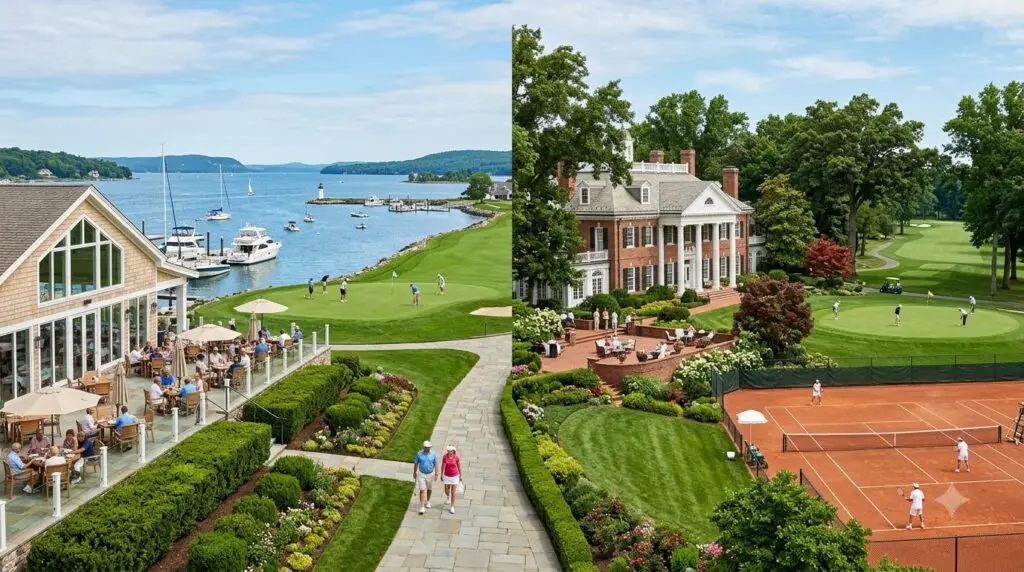
A waterfront setting can make a country club feel more like a retreat, but the view alone does not determine membership value.
Some waterfront clubs provide championship golf, dining, fitness, swimming, court sports, family programming, and access to lake-oriented recreation. Others offer little beyond a scenic location.
Traditional country clubs can provide many of the same amenities, sometimes with a more convenient location, stronger golf traditions, greater year-round accessibility, or a membership structure that better fits the household.
The better experience depends on:
- How often you will visit
- Whether golf is your main priority
- Which household members will use the club
- How important scenery and outdoor space are
- Distance from home or work
- Tee-time and facility access
- Complete membership cost
- Club culture
- Whether waterfront recreation is actually included
A waterfront country club is usually the stronger fit for someone who values the setting and intends to use the club for dining, recreation, family time, and social activities beyond golf.
A traditional club may provide better value when golf, convenience, established competition, or proximity is more important than a waterfront location.
What Is a Waterfront Country Club?
A waterfront country club is a private club located beside a lake, river, bay, or coastal area.
It may offer the same core facilities as another private club, including:
- Golf
- Practice facilities
- Clubhouse dining
- Fitness
- Swimming
- Tennis or pickleball
- Social events
- Family programming
- Private-event space
Its defining feature is its setting, not a guaranteed list of amenities.
A waterfront location may provide:
- Lake or shoreline views
- Outdoor dining
- Scenic event spaces
- A greater connection with the surrounding community
- Access to nearby boating or lake activities
However, membership does not automatically include marina slips, boat storage, fishing access, beach use, or other water privileges. These must be confirmed separately.
What Is a Traditional Country Club?
A traditional country club is a private club commonly organized around golf, dining, member events, and other recreational facilities.
It may be located:
- In a residential community
- Near a town or city
- In a suburban area
- On rural land
- Around a historic golf course
The term “traditional” does not necessarily mean outdated or golf-only.
Many established clubs now offer:
- Modern fitness centers
- Pools
- Racquet sports
- Junior programs
- Casual dining
- Social events
- Business facilities
- Family memberships
The meaningful comparison is therefore not “modern waterfront club versus old-fashioned golf club.”
It is:
Which specific club provides the facilities, access, culture, and location that best fit your household?
Waterfront vs. Traditional Country Club: Quick Comparison
| Factor | Waterfront country club | Traditional country club |
| Defining feature | Lake, river, bay, or coastal setting | Golf, heritage, location, or established club community |
| Golf quality | Depends on the individual course | Depends on the individual course |
| Scenery | May include water and shoreline views | May include golf, mountain, woodland, or neighborhood views |
| Dining atmosphere | Can include waterside patios or views | Usually centered around clubhouse and course |
| Water recreation | Sometimes available, not guaranteed | Usually not a central benefit |
| Convenience | May be farther from employment centers | May be closer to home, work, or town |
| Family amenities | Vary by club | Vary by club |
| Membership value | Strong when the setting and wider lifestyle are used | Strong when golf, location, and regular access are priorities |
| Potential limitation | Distance, seasonal facilities, waterfront premium | Fewer lake-oriented lifestyle benefits |
| Best fit | Members seeking a broader destination experience | Members prioritizing golf, convenience, tradition, or local community |
Neither category wins automatically.
1. Compare the Golf Experience First
A beautiful lake view cannot compensate for golf access that does not suit the member.
Compare:
- Course layout
- Number of holes
- Tee options
- Walking conditions
- Practice facilities
- Instruction
- Weekend availability
- Member tournaments
- Pace of play
- Seasonal maintenance
- Cart requirements and charges
- Reciprocal access
Water may influence the course’s scenery and strategy, but it can also introduce wind, elevation, drainage, or forced-carry challenges.
Do not assume that a waterfront course will be more relaxed or that a traditional course will be more competitive. Visit and play the actual course.
The Waterfront Country Club golf experience
The Waterfront Country Club in Moneta, Virginia, has an 18-hole, par-72 course designed by George Dillon. The course occupies a 750-acre community with 8.5 miles of shoreline, and its fairways were converted to Zeon Zoysia during a 2021 restoration. The club also provides a driving range, short-game areas, a putting green, instruction, and a Golf Shop.
Its current Golf Membership lists unlimited golf, practice-facility access, tournaments, club events, and reciprocal play. Actual booking availability, cart charges, guest fees, and reciprocal-club terms should be confirmed during the membership consultation.
2. Decide Whether the Setting Will Change How Often You Visit
A waterfront setting adds value only when it encourages real usage.
You may use a waterfront club more often for:
- Lunch or dinner
- Outdoor seating
- Family afternoons
- Social gatherings
- Evening relaxation
- Fitness
- Court sports
- Events
- Time near the lake
But location can also reduce use.
Ask:
- How long is the drive from home?
- Is the route convenient at night?
- Can you visit spontaneously?
- Will you travel there only on weekends?
- Do seasonal residents receive different membership options?
- Is the club practical during winter?
- Does the household already spend time near the water?
The Waterfront is located at 275 Anchor Drive in Moneta. The club estimates travel at approximately 40 minutes from Lynchburg and 45 minutes from Roanoke Regional Airport, although members should check actual travel time from their home during the hours they expect to visit.
3. Verify What “Waterfront Lifestyle” Actually Includes
Waterfront marketing can blur several different benefits.
These are not the same:
- Views of water
- Property beside the water
- Access to the shoreline
- Boat-launch access
- Marina or slip privileges
- Watercraft storage
- Organized lake activities
A club may offer one without offering the others.
Ask:
- Can members access the shoreline?
- Is there a marina?
- Are slips included, rented, or separately owned?
- Is boat storage available?
- Can members arrive by water?
- Are kayaking or paddleboarding facilities provided?
- Which amenities belong to the residential community rather than the club?
- Are water activities insured or supervised by the club?
The Waterfront’s official site promotes its Smith Mountain Lake setting, shoreline, outdoor activities, golf, dining, fitness, aquatics, and court sports. It does not state on its public membership page that marina slips or boat storage are included in standard memberships.
Those benefits should not be promised without direct confirmation.
4. Compare Non-Golf Amenities by Actual Use
Both waterfront and traditional clubs can provide broad lifestyle amenities.
The right comparison is not the number of facilities. It is how useful those facilities are to the household.
Fitness
Check:
- Equipment
- Hours
- Group classes
- Personal training
- Changing facilities
- Guest access
- Peak-time crowding
Swimming
Check:
- Seasonal dates
- Lap access
- Children’s areas
- Lifeguards
- Lessons
- Poolside food
- Guest policies
Court sports
Check:
- Tennis and pickleball availability
- Number of courts
- Surface
- Lighting
- Reservation rules
- Leagues
- Clinics
- Guest charges
The Waterfront currently lists tennis, pickleball, basketball, a fitness center, and a seasonal 25-meter pool with lap lanes, a children’s area, lifeguards, and poolside service.
A traditional club offering the same facilities closer to home may still provide greater practical value.
5. Evaluate Dining as a Standalone Benefit
Many members use club dining more frequently than golf.
Compare:
- Days and hours
- Casual and formal options
- Outdoor seating
- Menu variety
- Children’s choices
- Dietary accommodation
- Reservations
- Food minimums
- Private dining
- Guest access
- Service consistency
Water views can make a meal more memorable, but they do not replace food quality, operating hours, or reliable service.
The Waterfront currently lists The Gangplank dining room, a main bar and lounge, an outdoor patio, and private VIP rooms. The Gangplank provides course and lake views, lunch and dinner service, seasonal menus, and private-dining options.
Prospective members should dine at the club on an ordinary service day, not only during a carefully staged membership event.
6. Compare Family Value
A waterfront club may feel attractive to a family, but “family-friendly” should be supported by real access and programming.
Ask:
- Who qualifies as a family member?
- Are dependent children included?
- What happens when children reach a certain age?
- Are junior activities included?
- Are camps charged separately?
- Can children use the pool without an adult?
- Are there teen activities?
- Does the club offer family dining?
- Are holiday events frequent?
- Can grandparents bring grandchildren?
The Waterfront currently offers a Full Family membership that extends golf benefits to the household and lists family aquatics, children’s programming, junior golf, family events, priority event reservations, and a dedicated family locker room.
Confirm current schedules and additional activity fees before assigning financial value to these benefits.
7. Examine Club Culture
Two clubs with identical amenities can feel completely different.
One may emphasize competitive golf and formal traditions. Another may feel casual, multigenerational, and socially active. Neither is inherently better.
During a tour, observe:
- How members interact
- How staff greet people
- Whether new members are introduced
- The mix of ages and households
- Dress expectations
- Event participation
- Golf competitiveness
- Family presence
- Communication style
- How complaints or feedback are handled
Ask to attend:
- A normal dining service
- A member event
- A golf league or tournament
- A family activity
- A court-sport session
Club culture is difficult to measure from a website, but it strongly influences whether the membership feels comfortable.
8. Compare the Complete Membership Cost
A waterfront location may influence club pricing, but the setting alone does not reveal whether the membership offers good value.
Calculate:
Estimated first-year cost =
Initiation fee
+ annual or monthly dues
+ assessments
+ food minimums
+ cart or trail fees
+ lockers and storage
+ tournament or league fees
+ family-program charges
+ expected guest costs
Also ask about:
- Automatic renewals
- Annual increases
- Special assessments
- Upgrade and downgrade rules
- Resignation notice
- Refundability
- Membership pauses
- Property-owner requirements
- Nonresident qualifications
The Waterfront does not currently publish standard initiation fees or monthly dues. Its public site states that fees vary by membership type and availability and are provided during a personal consultation.
Request a written first-year and renewal estimate before comparing it with another club.
9. Understand Seasonal Limitations
A waterfront property may provide its greatest value during warmer months.
Potential seasonal factors include:
- Pool operating dates
- Outdoor dining
- Boating
- Lake traffic
- Weather
- Course conditions
- Club events
- Staffing levels
- Road access
- Daylight
The Waterfront’s pool is currently described as seasonal, operating primarily from Memorial Day through Labor Day, while fitness, dining, golf, and club events may operate on different schedules.
A year-round resident should ask what the club experience looks like in January, not only in July.
10. Compare Membership Categories
Different membership levels can change the comparison completely.
The Waterfront currently lists:
Golf Membership
Includes unlimited golf, practice facilities, dining, clubhouse access, court sports, fitness, pool, tournaments, events, and reciprocal play.
Full Family Membership
Includes Golf Membership benefits for the household, plus family aquatics, children’s programming, junior golf, family events, priority event reservations, and family locker-room access.
Social Membership
Includes dining, clubhouse, fitness, pool, court sports, social events, and opportunities for guest golf without standard course access.
A household that does not play golf may receive more value from a social membership at a waterfront club than from a full golf membership at either type of club.
Which Club Is Better for Your Lifestyle?
A waterfront club may be better when:
- The setting is important to your household
- You already spend time near the lake
- You will dine and socialize at the club
- Several household members will use the amenities
- Outdoor space matters
- You want the club to function as a recreational destination
- The travel time is practical
- The total cost fits your expected use
A traditional club may be better when:
- Golf is the main reason for joining
- The course is closer to home
- You value established leagues and competition
- Waterfront recreation is not important
- You want greater convenience
- The traditional club offers better tee-time availability
- Its culture suits you more closely
- The membership provides stronger value for the facilities you use
Neither may be right when:
- You expect to visit only occasionally
- The club is too far away
- Important facilities are seasonal
- Preferred tee times are difficult to secure
- Your family will not use the amenities
- The complete cost exceeds the value you expect
- Membership terms are unclear
Decision Checklist
Before joining either type of club, confirm:
Golf
- Course quality and difficulty
- Booking window
- Weekend availability
- Practice facilities
- Cart and trail fees
- Tournament access
- Reciprocal benefits
Lifestyle
- Fitness
- Pool
- Tennis and pickleball
- Family activities
- Dining
- Social calendar
- Outdoor spaces
Waterfront Benefits
- Actual shoreline access
- Marina or slip rules
- Water-recreation privileges
- Community versus club ownership
- Seasonal limitations
Financial Terms
- Initiation fee
- Dues
- Assessments
- Food minimum
- Guest fees
- Activity fees
- Cancellation and resignation rules
Practical Fit
- Travel time
- Household interest
- Expected visits
- Club culture
- Future membership flexibility
Frequently Asked Questions
What is the main difference between a waterfront and traditional country club?
A waterfront club is defined by its location beside a lake, river, bay, or coast. A traditional club may be defined more by golf, history, community, or location. Either type can offer golf, dining, fitness, swimming, court sports, and family activities.
Is a waterfront country club always more expensive?
Not necessarily. Costs depend on the individual club, facilities, membership demand, location, initiation fee, dues, and additional charges.
Are waterfront country clubs only for golfers?
No. Many offer social memberships covering dining, fitness, aquatics, court sports, and events without full golf privileges.
Does waterfront membership include boating?
Not automatically. Marina, boat-slip, launch, storage, and water-access privileges must be confirmed separately.
Which club is better for families?
The better family club is the one with useful age-appropriate programming, practical access, transparent fees, and facilities the household will actually use. The waterfront setting alone does not guarantee better family value.
What should I ask during a club tour?
Ask about total costs, tee-time availability, family eligibility, guest rules, seasonal hours, dining, programs, assessments, resignation terms, and any waterfront privileges.
What does The Waterfront Country Club offer?
The club currently lists an 18-hole golf course, practice facilities, dining, tennis, pickleball, basketball, fitness, a seasonal 25-meter pool, social events, and Golf, Full Family, and Social membership options.
How can I explore membership at The Waterfront?
The club invites prospective members to submit an inquiry or schedule a personal tour. Current fees, availability, guest policies, and category-specific terms should be confirmed during that consultation.
Final Verdict
A waterfront country club does not automatically provide a better experience than a traditional country club.
Its advantage is the possibility of combining private-club amenities with a setting that members genuinely want to visit for golf, dining, recreation, social activities, and relaxation.
A traditional club may still win when it offers:
- A more suitable golf course
- Better access
- A stronger cultural fit
- Greater convenience
- More attractive financial terms
The smartest decision is to compare how both clubs will function in your real life.
Tour each property more than once. Test the travel time. Review the booking calendar. Dine at the clubhouse. Inspect the facilities. Ask what the waterfront membership actually includes. Request the complete financial terms in writing.
Then choose the club you will use, not simply the one that photographs best at sunset.
Explore The Waterfront Country Club at Smith Mountain Lake
The Waterfront Country Club is a private club in Moneta, Virginia, established in 1981. Its current facilities include an 18-hole course, practice areas, clubhouse dining, court sports, fitness, aquatics, member events, and multiple membership categories within a 750-acre Smith Mountain Lake community.
A personal tour allows prospective members to examine the course, dining spaces, pool, fitness center, courts, setting, and club atmosphere while reviewing current membership availability and costs.
The tour should answer one central question:
Does the waterfront setting add practical value to the way our household will use the club?
When the answer is yes, The Waterfront can offer something a standard amenity comparison may miss: a club experience shaped not only by what members can do, but also by where they get to do it.